
Managing affiliate links manually wastes time and limits growth. AI tools automate the process, saving hours and boosting results. Here’s how AI improves affiliate link management:
- Automates tracking: AI tools like ThirstyAffiliates and AAWP monitor clicks, conversions, and performance without spreadsheets.
- Simplifies link insertion: Tools like Link Whisper and ClickWhale add affiliate links to content automatically, ensuring consistency.
- Optimizes campaigns: AI analytics track metrics like Earnings Per Click (EPC) and Conversion Rate (CR) to improve performance.
- Personalizes campaigns: AI-powered platforms like GetResponse create dynamic, tailored campaigns based on user behavior.
- Scales effortlessly: Automation reduces manual tasks, enabling you to manage thousands of links efficiently.
With the affiliate marketing industry expected to hit $20B by 2026, AI adoption is key to staying competitive. Tools like SEMrush, Ahrefs, and Your Automated Life make it easier to track, optimize, and scale AI-driven affiliate marketing strategies while cutting down on manual work.
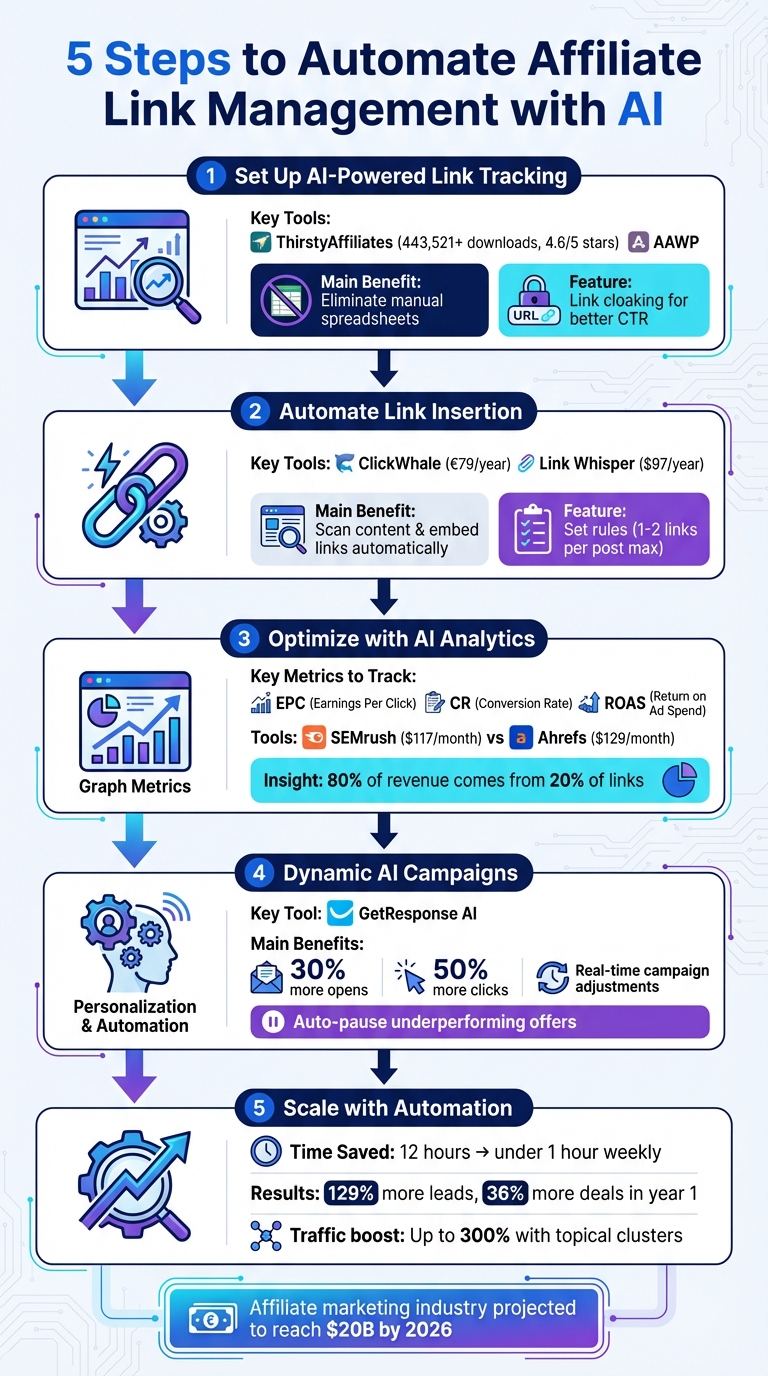
5-Step AI Affiliate Link Management Process
Step 1: Set Up AI-Powered Link Tracking
Why Track Affiliate Links
Manually tracking affiliate links can feel like trying to navigate without a map – it’s time-consuming and leaves you guessing about what’s actually working. Without tracking, you won’t know which links generate clicks, conversions, or commissions. For instance, Amazon Associates doesn’t provide reports on which specific links are being clicked. This lack of insight makes it almost impossible to fine-tune your strategy or figure out what’s driving results.
Tracking also safeguards your earnings. With the phase-out of third-party cookies by the end of 2023, first-party data collection has become essential. AI-powered tracking tools step in to give you a clear picture of your affiliate performance without relying on outdated cookie-based methods or guesswork.
Integrate AI Tools for Link Tracking
If you’re using WordPress, two standout plugins for automating link tracking are ThirstyAffiliates and AAWP. ThirstyAffiliates has been downloaded over 443,521 times and boasts a 4.6/5 star rating from 245 reviews . While ThirstyAffiliates works with all affiliate programs, AAWP is tailored specifically for Amazon Associates.
Getting started is simple. Install your chosen plugin via WordPress. ThirstyAffiliates features a 5-step onboarding wizard that helps you activate your license, choose features, and create your first affiliate link. Be sure to enable the "Statistics" module for tracking clicks and the "Google Click Tracking" module to integrate with Google Analytics. For AAWP users, activate click tracking in the settings and exclude admin roles to prevent your own clicks from skewing your data.
Both plugins also streamline your links by turning long, clunky affiliate URLs into neat, branded ones – a process known as "link cloaking." This not only improves click-through rates but also protects your commissions . If you’re promoting Amazon products, enable "Smart Uncloaking" and query string passing to preserve tracking parameters . For better organization, group your links into categories, making it easier to filter and analyze reports later .
AAWP offers even more detailed insights, showing exactly what part of a product box – like the image, title, or button – was clicked. It also tracks the user’s device, browser, and operating system. Meanwhile, ThirstyAffiliates provides a centralized dashboard within WordPress to manage, track, and update all your affiliate links, eliminating the need for manual spreadsheets . Features like the "Automatic 404 Checker" ensure your links stay functional without constant monitoring .
"ThirstyAffiliates is designed to simplify the click-tracking process… making it a breeze to monitor and analyze your affiliate link performance… without the need to touch a single line of code or hire a developer." – ThirstyAffiliates
ThirstyAffiliates pricing starts at $99.60 per year for a single website, with plans for up to 10 websites available for $149.70 annually.
Once tracking is set up, you’ll be ready to move on to automating link insertion.
sbb-itb-4bfa3ba
Step 2: Automate Link Insertion Across Content
AI-Powered Link Placement
Once you’ve set up AI-powered link tracking, the next step is automating link insertion. Tools like ClickWhale and Link Whisper simplify this process by scanning your content for keywords and embedding affiliate URLs automatically. For example, ClickWhale allows you to define a target URL and its keyword variations (e.g., "Bluehost" vs. "Blue Host"). The AI then searches your site – including older or archived posts – and applies the link seamlessly.
Link Whisper takes a slightly different approach. It uses AI to find "link opportunities" by identifying every instance of a target keyword across your site. Before finalizing, you can review the context to ensure the link feels natural within the content. This "Select Links Before Inserting" feature gives you more control over placement, making it easier to maintain quality and relevance in your posts.
By automating link placement, you’re laying the groundwork for consistent and efficient monetization across your site.
Set Rules for Automated Insertion
To keep your content organized and avoid overwhelming readers, it’s essential to set clear rules for automated link placement. For instance, limit the number of automated links per post to one or two. Additionally, make sure links are labeled with "nofollow" and "sponsored" attributes and use a 307 redirect to maintain flexibility.
You can also control where automated links appear by targeting specific content types. For example, you might apply links only to blog posts or product reviews while skipping areas like the homepage, archive pages, or headers. These global settings help keep your site clean and professional.
As for pricing, ClickWhale Pro starts at €79 per year for a single site (with options for multiple sites), while Link Whisper begins at $97 annually. With these tools and rules in place, your system is ready for smarter, data-driven link management.
Ai Content Assembly Line – How I Automated My Affiliate Marketing Business!
Step 3: Optimize Affiliate Links with AI Analytics
Once you’ve automated link placement, the next step is understanding how well your strategy performs. This is where AI analytics comes into play, offering detailed insights into the effectiveness of your affiliate links. This level of AI automation for passive income allows creators to scale without sacrificing personal time.
Key Metrics to Track with AI Analytics
To make informed decisions, focus on metrics that directly impact revenue. These include Earnings Per Click (EPC), Conversion Rate (CR), Assisted Conversions, and Return on Ad Spend (ROAS). Here’s a quick breakdown:
- EPC: This measures the average revenue you earn per click. Higher EPC means your links are driving better returns.
- CR: This shows how efficiently clicks on your links turn into actions, like purchases or sign-ups. A high click-through rate but low CR might indicate a mismatch between your content and the landing page.
- Assisted Conversions: These track the contributions of upper-funnel content, such as detailed blog posts, to overall conversions. Research suggests that 80% of affiliate revenue comes from just 20% of your links.
- ROAS: For paid campaigns, aim for at least a 3x return on ad spend.
Ahrefs’ Traffic Potential metric is another valuable tool. Unlike raw search volume, it estimates actual clicks by considering factors like Google’s featured snippets. This helps you prioritize the keywords and content that are likely to drive the most traffic.
SEMrush vs. Ahrefs: Feature Comparison
SEMrush and Ahrefs are two leading tools for affiliate link optimization, each catering to different needs. SEMrush is a comprehensive marketing platform, integrating SEO, PPC, social media, and content tools – perfect for managing campaigns across multiple channels. On the other hand, Ahrefs is designed for in-depth SEO research, excelling in backlink analysis and technical audits.
In April 2024, SEMrush enhanced its internal affiliate program, BeRush, by connecting its Traffic Analytics API to internal data. This automation allowed them to process data for 30,000 partners, cutting manual work from 2 hours daily to just 30 minutes – a 75% efficiency boost.
Here’s a side-by-side comparison of their features:
| Feature | SEMrush | Ahrefs |
|---|---|---|
| Primary Strength | All-in-one marketing (SEO/PPC/Social) | Deep backlink and technical SEO research |
| Backlink Database | 43 trillion links | 35 trillion links |
| Keyword Database | 27.3 billion keywords | 28.7 billion keywords |
| Unique Metric | Keyword Intent and PPC integration | Traffic Potential (actual click estimates) |
| AI Visibility Tracking | Daily prompt-level tracking | Brand-level "Share of Voice" trends |
| Best For | Full-stack marketers and agencies | SEO specialists and link builders |
| Starting Price | ~$117/month (annual billing) | $129/month |
SEMrush’s Keyword Intent feature is particularly useful for aligning affiliate links with "Commercial" or "Transactional" queries, boosting conversion rates. Meanwhile, Ahrefs’ Traffic Potential metric helps identify keywords likely to generate actual clicks, making it a great tool for deciding which product reviews to write. Both platforms now also track visibility in AI-driven answers, such as those from ChatGPT and Perplexity, reflecting the increasing role of AI in driving traffic.
"Semrush wins overall for 2025. It outperforms Ahrefs in keyword research, LLM visibility, technical SEO, PPC, and pricing." – Backlinko
Step 4: Use AI for Dynamic Affiliate Campaigns
Once you’ve fine-tuned your analytics, the next step is automating your campaigns to make them more dynamic and responsive. Static campaigns often fall short when it comes to engaging your audience. AI-powered tools, like GetResponse AI, can help you create campaigns that adapt in real time based on how subscribers interact with your content.
Create Personalized Campaigns with AI
GetResponse AI makes it easy to generate marketing campaigns tailored to your product, industry, and audience. In just a few minutes, the tool can create a landing page, welcome email, and newsletter – all based on the details you provide.
Behavioral triggers are a game-changer for personalized follow-ups. For example, if someone checks out a specific product page, downloads a resource, or clicks a link, AI workflows can automatically send them relevant follow-up emails. Dynamic content blocks take it a step further by customizing elements like images, product recommendations, and calls-to-action. This means one email template can show different content to users in New York versus Los Angeles, depending on their location or past behavior.
AI also uses predictive personalization to analyze user behavior and figure out which offers are most likely to appeal to each individual. Features like GetResponse’s "Perfect Timing" ensure emails land in inboxes at the exact moment recipients are most likely to open them. For ecommerce affiliates, AI-driven campaigns such as "Price Drop" alerts notify customers when the price of a product they’ve viewed decreases. These types of segmented, automated campaigns can lead to impressive results – 30% more opens and 50% more clicks compared to generic messaging.
This level of personalization is key to making campaigns more effective and responsive.
Automate Real-Time Campaign Adjustments
Managing campaigns manually can slow you down, especially when constant tweaks are needed. AI tools can monitor your campaign performance around the clock and make adjustments automatically. For instance, you could set a rule like: “If CPA increases by 10% or EPC drops below $0.30, pause the offer and send me a Slack notification”.
Advanced AI systems analyze metrics like Earnings Per Click (EPC) and Return on Ad Spend (ROAS) in real time. They can shift budgets from low-performing ads to high-performing ones without waiting for manual input. While traditional A/B testing might take weeks, AI can test multiple variations simultaneously and deliver actionable insights in just three days.
"If your day disappears into link edits and banner tweaks, you’re not running a program – you’re babysitting it." – Zeely AI Blog
AI doesn’t just stop at performance metrics. It can also scan for issues like 404 errors, check if offers are still available, and detect when ad creatives are losing their effectiveness – all without you having to lift a finger. This constant monitoring ensures your campaigns are always optimized and ready to adapt to performance changes, no matter the time of day.
Step 5: Scale Affiliate Link Management with Your Automated Life
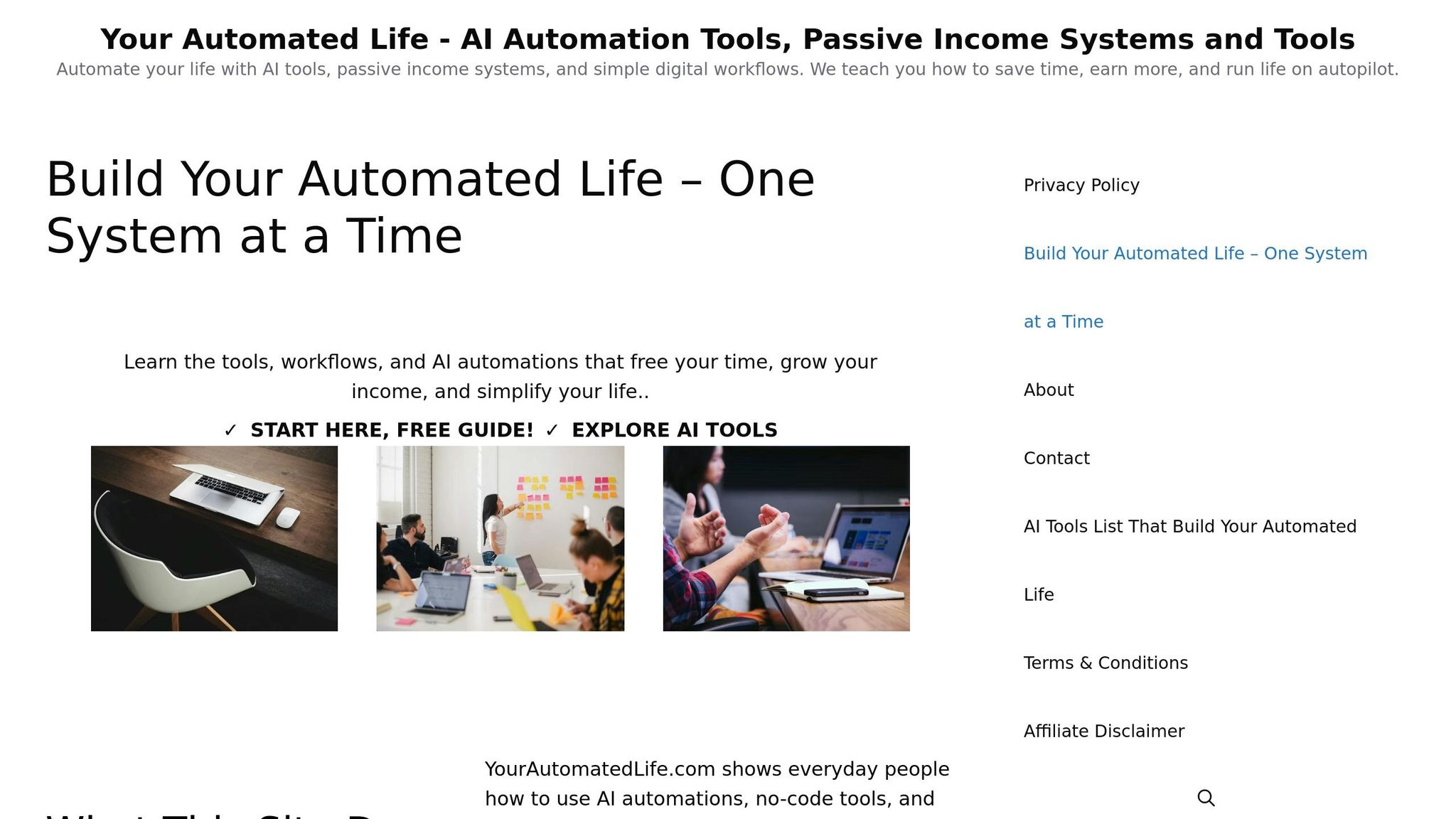
Once you’ve automated tracking, link insertion, and campaign optimization, the next challenge is scaling these processes without adding more manual work. Managing affiliate links manually can eat up hours of staff time, but automation allows your team to shift focus from repetitive tasks to strategies that drive growth. Tools like Your Automated Life provide pre-built workflows and no-code solutions, freeing you from constant monitoring and enabling a fully automated, 24/7 system.
For instance, the AI Autopreneur Starter Kit integrates platforms like Zapier, Notion AI, and Google Sheets to streamline link insertion and tracking. Andrew Best, a user of this system, reported saving 15 minutes per article by automating hyperlinking. This kind of efficiency makes it easier to scale your efforts using simple, no-code tools.
To further enhance scalability, platforms like Scaleo or Hyros allow you to set up guardrail rules. These rules can automatically pause underperforming links or boost high-converting ones using real-time metrics like EPC (Earnings Per Click) and ROAS (Return on Ad Spend). One midsize fashion brand, for example, reduced their weekly link management time from 12 hours to under one hour, while also cutting waste by 25%.
Automation isn’t just a convenience – it’s a necessity:
"If you’re still managing affiliate campaigns by hand, you’re already behind." – Zeely AI
Your Automated Life also offers resources for creating topical content clusters using AI. These clusters help identify connections between subtopics, which can increase site traffic by as much as 300%. By integrating these clusters with your automated system, you can amplify the benefits of AI to drive both traffic and revenue growth. Additionally, the ProfitPassively.com Checklist provides a step-by-step guide for setting up an AI-powered affiliate system that works around the clock. Automated systems have been shown to generate 129% more leads and close 36% more deals within the first year, making it possible to scale your affiliate link management without risking burnout.
Conclusion
This five-step guide shows how AI can turn manual affiliate link management into a round-the-clock automated system. By automating tasks like tracking, insertion, and scaling, you can reclaim time to focus on strategy and growing your business.
The numbers back it up: the affiliate marketing industry is on track to hit $20 billion by 2026, driven in part by automation’s impact. As Ollie Efez said in February 2026:
"AI doesn’t replace the affiliate marketer. It empowers them with a co-pilot that can process staggering amounts of information in an instant, freeing them up to focus on what really matters: strategy and building stronger partnerships."
Starting small, such as automating link tracking, can lead to big wins. Over time, you can scale up, clean your data regularly, use trigger-based rules to manage budgets, and keep a "human-in-the-loop" to ensure your brand’s voice and accuracy remain intact.
With these approaches in place, the tools and strategies in this guide can help you transition smoothly from manual to automated link management. Whether you’re dealing with a few links or managing thousands, AI takes care of the heavy lifting, leaving you free to focus on what truly matters: building stronger partnerships, running smarter campaigns, and achieving steady growth.
For ready-made workflows and step-by-step instructions, check out Your Automated Life (https://yourautomatedlife.com). No technical skills? No problem – they’ve got you covered.
FAQs
What’s the fastest way to start automating affiliate link tracking?
The fastest way to streamline affiliate link tracking is by using AI tools and no-code solutions. For instance, tools like ChatGPT and Google Apps Script can help you create systems that automatically insert affiliate links into your content. Alternatively, AI-driven platforms with pre-built automation features can take care of tracking, updating, and optimizing links. This approach not only saves time but also reduces the need for advanced technical skills.
How do I stop auto-inserted links from hurting readability or SEO?
When adding links to your content, make sure they fit naturally and don’t disrupt the flow of the text. Irrelevant or poorly placed links can hurt both readability and SEO. Using AI tools to manage links can make this process smoother by ensuring they’re positioned effectively. For example, tools like PrettyLinks let you create short, branded URLs that are easier for users to engage with while also boosting SEO. Prioritize placing links strategically and in a way that makes sense within the context of your content to keep things readable and effective.
Which metrics should I watch first to improve affiliate revenue?
To increase your affiliate revenue, pay close attention to three key metrics: click-through rates, conversion rates, and earnings per product or link.
- Click-through rates help you identify which links are grabbing the most attention and driving traffic.
- Conversion rates show how effectively that traffic turns into actual commissions.
- Earnings per product or link highlight which offers are generating the most income.
By analyzing these numbers, you can fine-tune your approach and focus on the strategies that yield the best results.