If you’re juggling a full-time job, family, and other responsibilities, finding time for a side hustle can feel impossible. But what if you could earn extra income without trading hours for dollars? That’s where AI automation comes in. Instead of working more, you can set up systems that generate income in the background with minimal effort after the initial setup.
Here’s how AI automation can help you:
- Affiliate Marketing: AI tools create and publish content, manage campaigns, and track performance automatically, letting you earn commissions without constant involvement.
- Faceless YouTube Channels: AI generates scripts, voiceovers, and visuals, making it easy to run a YouTube channel without appearing on camera.
- Selling Digital Products: Create once, sell repeatedly. AI handles design, marketing, and delivery for products like eBooks, templates, and online courses.
- No-Code Automation: Tools like Zapier automate repetitive tasks like email responses, lead management, and subscription billing, saving time and energy.
AI automation flips the traditional side hustle model by turning upfront effort into long-term, passive income streams. Whether it’s earning affiliate commissions, growing a YouTube channel, or selling digital products, these systems work 24/7, freeing up your time for what matters most.
Why AI Automation Works Better Than Traditional Side Hustles
The Time Problem with Traditional Side Hustles
Most traditional side hustles rely on a simple equation: trade your time for money. Take driving for a rideshare service, for example. You only earn when you’re actively driving. Freelance writing? Every piece demands hours of research, writing, and revisions. Selling handmade crafts? Each item requires your personal attention, from production to packaging.
The problem? The math doesn’t always add up. Imagine you’re a freelance graphic designer earning $50 per hour. Sounds good, right? But once you account for unpaid tasks – like client emails, revisions, and invoicing – that hourly rate can shrink to $30 or less. Suddenly, that “decent” pay doesn’t seem so great.
Another issue is the rigid time commitment. Most side hustles require consistent, predictable hours. If you take a week off, your income stops. Skip a few freelance gigs, and you might lose clients altogether. It’s like taking on another job with the same grind as your main one – hours for dollars, with no flexibility.
And let’s not forget the skill gap. Many high-paying side hustles require expertise you may not have. Learning video editing, SEO writing, or coding doesn’t happen overnight. Even running an online store demands time to master inventory management, customer service, and marketing. You’re not just working; you’re also spending time learning how to work.
The result? Burnout. After a 40- to 50-hour workweek at your main job, squeezing in another 10 to 20 hours for a side hustle leaves little room for downtime, family, or even basic self-care. Weekends become extensions of your workweek, and the extra cash comes at the cost of your well-being.
This is where AI automation changes the game. It flips the script, turning time from a limitation into an asset.
How AI Tools Run Continuously Without Your Input
Unlike traditional side hustles that demand constant effort, AI tools work tirelessly in the background. They operate while you’re sleeping, spending time with family, or handling other priorities. Once you’ve set them up, they take over repetitive tasks without requiring your ongoing attention.
Here’s how it works: imagine setting up an AI-driven content creation system. You define the parameters – topics, keywords, posting schedule – and the tool takes care of the rest. It generates and publishes content at the best times, tracks performance, and grows your audience. All of this happens without you lifting a finger. AI doesn’t need breaks, doesn’t get tired, and doesn’t forget deadlines.
What’s the real benefit for busy people? You’re not eliminating work entirely, but you’re changing how and when you work. Instead of daily grind tasks, you might spend a few hours building a system, then check in briefly every week or two to tweak and monitor it. Meanwhile, the heavy lifting – content creation, publishing, customer interactions – happens automatically.
The same principle applies to selling digital products. Let’s say you create an e-book, a template, or an online course. Once it’s ready, AI tools handle everything from marketing to payment processing to delivery. Automated email campaigns nurture potential buyers, and sales happen without your direct involvement. One product, created once, can generate income for months or even years with minimal upkeep.
AI automation also removes the traditional earnings cap. Whether you have 10 customers or 10,000, the time you spend managing the system doesn’t change much. Scaling up doesn’t mean working more hours; it means fine-tuning systems that already run themselves.
To be clear, this isn’t about making money overnight with zero effort. You’ll need to invest time upfront to learn the tools, test strategies, and refine your systems. But this upfront work builds long-term assets. Instead of trading hours for immediate pay, you’re creating systems that generate income over time. Each automated workflow you design adds to your earning potential without adding to your daily workload.
For anyone balancing a career, family, and personal responsibilities, this approach is a game-changer. It allows you to build income streams that work alongside your life, quietly running in the background while you focus on what truly matters.
Easiest Passive Income – $4,041/mo Selling Digital Products with A.I.
AI-Powered Affiliate Marketing: Automated Commission Earning
Affiliate marketing offers a way to earn commissions by recommending products, but traditional methods often demand constant effort – creating content, engaging with audiences, and tracking performance. With AI automation, these tasks can be streamlined, allowing systems to run with minimal daily input.
Selecting a Profitable Affiliate Niche
For busy professionals, automating affiliate marketing requires efficiency without cutting corners. Choosing the right niche is critical – it can mean the difference between earning $50 a month or $5,000. The key lies in balancing three factors: your expertise, market demand, and commission potential.
Start with topics you already know. For instance, if you work in finance, promoting personal finance products makes sense. If you’re in tech, software and gadgets are natural fits. Leveraging your existing knowledge helps you configure AI tools more effectively and ensures your content feels authentic.
Next, confirm there’s demand. While AI tools can analyze search trends and data, you can also start with simple research. Check Amazon’s bestseller lists, see what’s trending on social media, or explore popular YouTube channels in your niche. Focus on areas where people are already spending money rather than trying to create demand.
High-commission programs are another crucial factor. For example, a $500 subscription with a 30% recurring commission can generate $150 monthly per customer. Compare that to a $20 product with a 5% commission – you’d need to sell 150 of those every month to match the income from just one high-ticket referral. Programs in areas like web hosting, email marketing, and online courses often pay $100 to $500 per sale or offer 20% to 50% recurring commissions. Ten customers subscribing to a $50 monthly service could bring in $500 in passive income, and doubling that number means $1,000 per month.
Avoid broad, oversaturated niches like "weight loss" or "make money online." Instead, narrow your focus with specific angles like "strength training for busy parents" or "passive income strategies for teachers." AI tools perform better when given clear, targeted parameters rather than generic topics.
Automating Content Creation and Publishing
AI writing tools can handle everything from blog posts to product reviews, comparison articles, and even social media content – all without you typing a single word. You simply provide the framework: product names, features, keywords, and your affiliate links. The AI then generates polished, structured content around these inputs.
To streamline this process, create reusable templates for your content. For a product review, include sections on features, benefits, pricing, and alternatives. For a comparison article, outline the products and criteria for evaluation. Once the templates are ready, the AI fills in the details, ensuring consistency across all your content.
Publishing can be automated too. Scheduling tools can connect to your blog, social media, or email platforms, allowing you to set up a content calendar. For example, you might schedule blog posts for Mondays and Thursdays, social media updates twice daily, and email newsletters every Sunday morning. With the system in place, this process runs on autopilot, often requiring just a few hours of setup each month.
While AI handles most of the heavy lifting, quality control is still essential. Review the first few pieces of content carefully and refine your instructions to ensure the output meets your standards. Over time, the need for edits will decrease. You can then shift to weekly reviews, making quick adjustments rather than starting from scratch.
Diversify your content formats to maximize reach. A single blog post can be repurposed into multiple formats: a Twitter thread, an Instagram carousel, a LinkedIn article, or an email newsletter. This approach transforms one piece of content into several assets, all created and scheduled automatically.
With content creation and publishing on autopilot, the next step is using AI to monitor and refine your campaigns.
Monitoring and Improving Campaign Performance
AI analytics bring together data from your affiliate dashboards, website, and social media accounts, making it easy to track trends and identify opportunities. You’ll see which products generate commissions, which content drives the most traffic, and which platforms convert best.
But AI goes beyond basic reporting. It can uncover patterns, like "product reviews posted on Thursdays get 40% more clicks than those posted on Mondays" or "comparison articles generate twice as many sales as single product reviews." Armed with this information, you can tweak your automation rules to focus on what works – prioritizing specific content types or posting schedules that yield better results.
Performance data also helps you cut inefficiencies. For example, if only two of the ten products you promote generate commissions, AI tools can highlight this imbalance. You can then shift your efforts toward the profitable products and stop wasting time on those that don’t convert.
AI can even automate A/B testing, experimenting with different headlines, calls-to-action, or content formats to see what resonates most. A headline that boosts click-through rates by just 15% might seem small, but across hundreds of posts and thousands of visitors, it can lead to noticeable increases in your earnings.
Set up alerts for major changes. If traffic suddenly drops, commissions spike, or a top-performing link stops converting, you’ll be notified right away. This allows you to address issues quickly rather than discovering them weeks later during a routine review.
Once your system is running smoothly, monitoring takes minimal time. A quick check of your dashboard once or twice a week is often enough. You’ll spend just 30 minutes reviewing AI-generated insights and making adjustments, compared to the hours it would take to manually analyze data from multiple platforms. Let the AI handle the heavy analysis – you just focus on making strategic decisions based on its findings.
Faceless YouTube Channels: Video Content Without Appearing on Camera
Just like AI has revolutionized affiliate marketing, it’s also changing the game for video creation. YouTube’s billions of daily views prove that success doesn’t require you to be in front of the camera. With AI tools, you can now handle everything – from scripting and voiceovers to visuals – without ever stepping into the spotlight. It’s a seamless way to create professional-quality videos entirely behind the scenes.
This method works across a wide range of topics, whether it’s productivity, finance, tech, meditation, or education. What matters most to viewers is the quality of the content, not who’s presenting it. Let’s dive into how AI can turn a simple script into a fully produced video in just minutes.
Using AI to Generate Videos Automatically
In the past, creating videos meant learning editing software, recording audio, and sourcing visuals – skills that could take months to master. Now, AI tools have drastically simplified the process. It all starts with a script. For instance, ChatGPT can generate a well-structured script in minutes if you give it a topic like “5 Budgeting Mistakes People Make in Their 30s.” You’ll get an outline with a clear introduction, main points, and conclusion, leaving you with minimal tweaks to make.
Once your script is ready, platforms like Pictory and Descript take over. These tools transform your text into a polished video. Simply upload the script, pick an AI voice, and select stock visuals. The software handles everything – syncing voiceovers, overlaying text, and matching video clips.
"I had zero video editing skills. Enter Pictory and Descript. Upload a script, pick a voice, drag in some stock footage. Suddenly, I had a faceless YouTube channel generating passive income – without ever showing my face." – Income AIcademy
Pictory is great for creating straightforward explainer videos using stock footage, while Descript offers more advanced editing options. Both platforms provide access to extensive libraries of video clips, images, and music tracks, so you’re never starting from scratch.
Consistency is key to growing your channel. AI tools make it possible to produce multiple videos in the time it used to take to create just one. As you get started, review your early videos to ensure the voiceovers sound natural, visuals align with the script, and the pacing keeps viewers engaged. A little extra effort upfront can save you from time-consuming edits later.
Automated Scheduling and Performance Tracking
After producing your videos, AI can also help you manage your channel’s growth. YouTube’s native scheduler lets you batch-upload content, while tools like TubeBuddy and VidIQ provide insights to optimize titles, tags, and thumbnails. For example, instead of a generic title like “Budgeting Tips,” you could use something more specific and engaging, like “5 Budgeting Mistakes Costing You $500 Every Month.” Numbers and clear benefits grab attention.
These tools also pull data from YouTube Analytics and display it in easy-to-read dashboards. You’ll quickly see which videos are driving the most watch time, attracting subscribers, or performing well across different traffic sources. Use this data to refine your strategy – adjust video lengths, experiment with upload schedules, or double down on topics your audience loves.
Faceless YouTube channels are a scalable way to build passive income. Many creators have shared stories of earning enough ad revenue to cover major expenses like rent. With AI handling the heavy lifting – video production, scheduling, and performance tracking – you can focus on growing your channel and creating content that resonates with your audience, all while the system runs quietly in the background.
sbb-itb-4bfa3ba
Selling Digital Products with Minimal Ongoing Work
Selling digital products is one of those ventures where AI does the heavy lifting, taking care of repetitive tasks while you focus on the big picture. These products are a great way to generate passive income – you create them once, and they can sell over and over without the hassle of managing inventory or shipping. With AI tools handling design and marketing, you can set up an automated system that runs with minimal involvement, similar to AI-powered affiliate marketing or running faceless YouTube channels.
The trick is to pick products that meet a specific need and fill a noticeable gap in the market. Once you’ve nailed down what to sell, AI tools can help you create high-quality products quickly. From there, automated platforms take over, managing hosting, payment processing, and customer delivery seamlessly.
Choosing Digital Products That Sell
The best digital products solve a specific problem for a targeted audience. For instance, eBooks continue to be popular, especially in niches like personal finance, productivity, and self-improvement. Templates are another hit – think budget spreadsheets, resume layouts, social media calendars, or meal planners. People love tools that save them time, making these options consistent sellers. Printables, such as wall art, planners, checklists, and educational worksheets, are also in demand. Once you upload the file, it’s available to customers indefinitely without any extra work. Courses and guides can perform well too, as long as they focus on clear, actionable outcomes that highlight the benefits users will gain.
To find your niche, research what’s already selling. Check out trending digital products, study how they’re presented, and read customer reviews. Look for gaps – like missing beginner-friendly investing guides or minimalist budget templates – and position your product to fill that void.
Using AI for Product Creation
AI tools make creating digital products faster and easier. For example, Canva offers customizable templates for eBooks, planners, and social media graphics. You can tweak colors, fonts, and layouts to match your brand, then add your content for a professional finish.
If you’re working on an eBook, tools like ChatGPT can help generate outlines, draft chapters, or even flesh out entire sections. For example, you might ask, “Create a 10-chapter outline for a beginner’s guide to budgeting, with actionable tips for each chapter.” Once you’ve refined the content, you can drop it into a Canva template, add visuals, and finalize your product.
Templates are even simpler to create. For instance, if you’re designing a monthly budget tracker, you can use Canva’s pre-made designs and customize them by adding sections like "Income", "Fixed Expenses", "Variable Expenses", and "Savings Goals." AI can also provide tips or prompts to include in each section, making the template even more user-friendly.
When it comes to printables – like wall art, planners, or checklists – Canva’s drag-and-drop interface makes the process straightforward. Choose a trending color scheme, such as neutral tones or minimalist designs, and let AI help brainstorm ideas. For example, you could ask, “What are 10 popular printable ideas for home organization?” and use the suggestions as a starting point.
This entire process – from brainstorming to a finished product – can often be completed quickly. Once you’ve created one product, you can easily adapt it into multiple variations, building a diverse catalog that increases your chances of steady sales.
Automating Sales and Marketing Processes
Platforms like Etsy and Gumroad make selling digital products a breeze by automating hosting, payments, and delivery. On Etsy, you can upload your printable files, write a description, set a price, and start selling. It’s a great platform for reaching an audience that’s already searching for templates, planners, and similar products. While Etsy charges small listing and transaction fees, it provides strong visibility for your products. Gumroad, on the other hand, is perfect for selling eBooks, courses, and guides, offering an easy setup for creators.
AI can also help you optimize your product listings. By generating effective keywords and compelling descriptions, AI ensures your products are easier to find and more appealing to potential buyers. For example, focus on highlighting the benefits your product provides rather than just listing features. AI tools can even craft engaging social media captions to promote your products, and platforms like Buffer can schedule posts to keep your marketing consistent.
Email marketing is another area where automation shines. Platforms like Mailchimp or ConvertKit allow you to set up email sequences that run on autopilot. You can welcome new subscribers with a discount or introduce them to your top products – all without needing to manually follow up.
The beauty of selling digital products lies in its scalability. Whether you’re making a handful of sales or hitting high volumes, the system works the same. By periodically reviewing performance data and tweaking your offerings, you can keep the process running smoothly while AI handles the rest. It’s a perfect example of how automation can turn a simple idea into a steady stream of passive income.
No-Code Automation for Custom Workflows
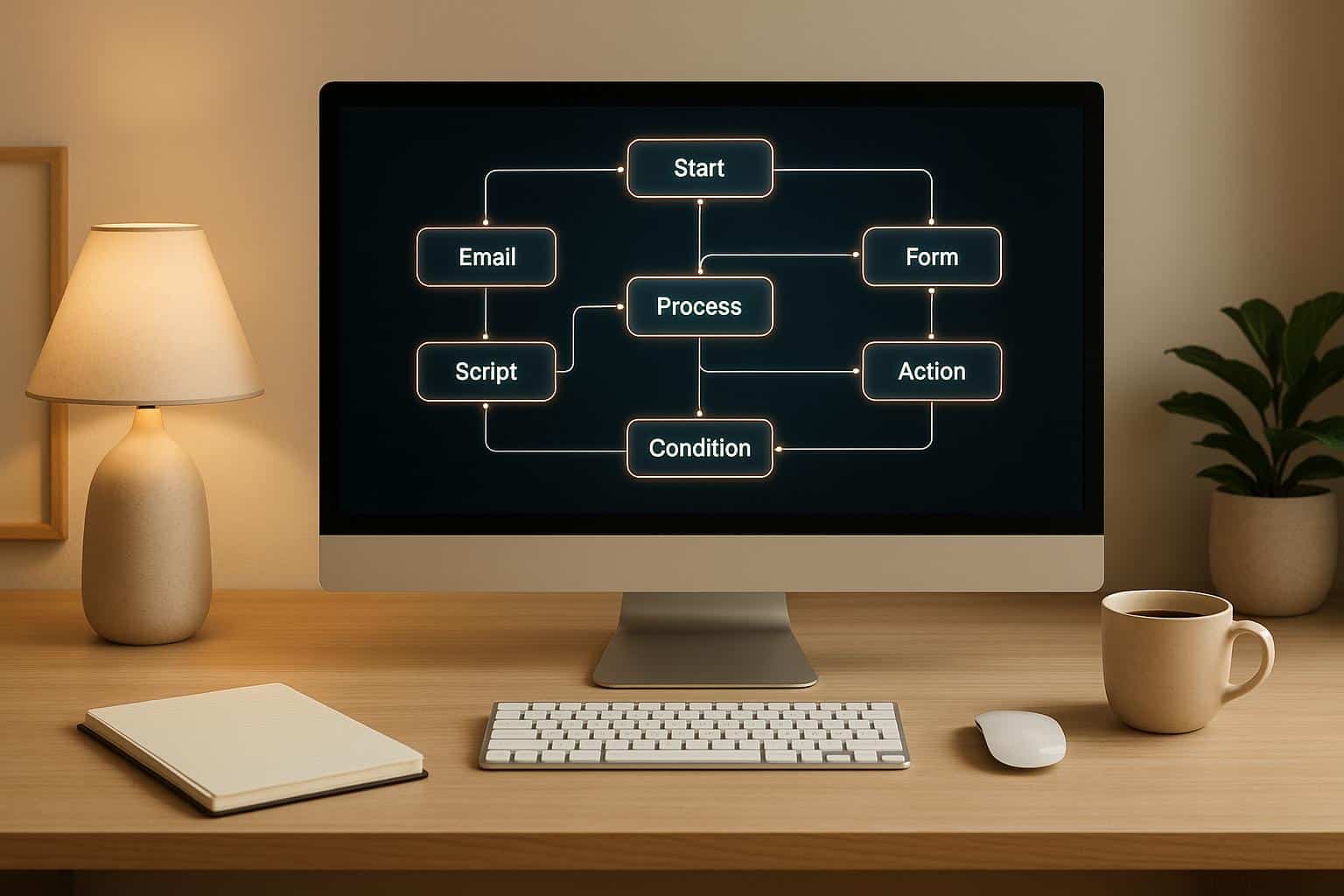
No-code platforms empower you to automate workflows without needing to write a single line of code. These tools rely on visual interfaces – like drag-and-drop builders – that allow you to connect various apps and services, creating custom automation systems that function seamlessly on their own. With them, you can automate tasks like managing customer inquiries or handling lead generation. Similar to how AI is used in affiliate marketing and video production, no-code automation sets up systems that keep running without constant supervision.
The beauty of no-code automation lies in its adaptability. You’re not stuck with rigid, pre-made solutions that may not fit your exact needs. Instead, you can design workflows tailored to your specific goals, whether it’s managing an affiliate marketing funnel, providing customer support for digital products, or tracking sales data across multiple platforms. These systems operate around the clock, processing tasks and transferring information automatically, leaving you with more time to focus on growing your business.
Platforms like Zapier, Make (formerly Integromat), and Airtable have made automation accessible to everyone. Zapier, for instance, integrates with thousands of apps, enabling you to create "Zaps" that trigger specific actions based on events. Make allows for more advanced workflows, including branching logic and data manipulation. Airtable combines spreadsheet features with automation tools, making it ideal for organizing databases that connect with other systems. The learning curve is manageable – most people can build their first workflow in under an hour. Next, let’s explore how these tools can eliminate repetitive tasks.
Automating Repetitive Tasks
Repetitive tasks can drain your time and energy. Activities like answering the same customer questions, manually updating spreadsheets, or sending follow-up emails can feel endless. No-code automation steps in to handle these tasks instantly and accurately, reducing errors and freeing you from the monotony.
Take email responses, for example. If you’re selling digital products and frequently receive inquiries about downloads, refunds, or product features, you can set up an automated system to categorize incoming emails and send appropriate responses. For simple questions like "How do I download my purchase?", the system can send detailed, step-by-step instructions immediately. More complex queries can be flagged for manual follow-up.
Customer support can also benefit from automation. Chatbots, like ManyChat, integrate with platforms like Facebook Messenger and Instagram, allowing you to create conversation flows that address common questions, collect user information, and even process orders. These bots handle initial interactions, such as providing pricing details or troubleshooting steps, and escalate only when necessary.
Lead management becomes almost effortless with automation. Imagine you run an affiliate marketing site with a newsletter signup form. Every new subscriber’s details can be automatically added to your email marketing platform, tagged based on the content they downloaded, and enrolled in a welcome email sequence. Their information can also be logged into a Google Sheet or Airtable database for tracking. From there, further interactions can update their tags and trigger targeted email campaigns – all without you lifting a finger.
Building Recurring Income Systems
Automation doesn’t just streamline tasks – it also powers predictable revenue models. Recurring income systems, such as subscriptions, memberships, or retainer services, generate steady revenue month after month. No-code automation simplifies these processes, from billing to content delivery and customer management.
For subscription-based services, platforms like Gumroad or Patreon can work with no-code tools to automate the entire process. Let’s say you offer a monthly newsletter with exclusive content. You can create a system where new subscribers are automatically billed each month, added to your email list, and sent that month’s content. For example, Make can track new payments in Gumroad, add the subscriber to ConvertKit with a specific tag, and deliver the latest issue immediately. When subscriptions renew, the next month’s content is sent automatically, and cancellations trigger removal from the list.
Membership sites operate in a similar way. Payment processors handle transactions, while no-code workflows manage access and content delivery. You can design systems that grant access to private communities, schedule new content releases, and notify members when updates are available.
Even retainer services can benefit from automation. For instance, if you offer a monthly social media content package, the onboarding process can be fully automated. When a client signs up, they can receive a welcome email with a questionnaire about their branding preferences. Their responses are stored in an Airtable database, triggering notifications that help you get started. Invoicing and reminders through Stripe or PayPal can also be automated, ensuring smooth operations.
The secret lies in setting up the right triggers and actions. A trigger – like a new payment or form submission – initiates the workflow, while actions – such as sending emails or updating databases – follow in sequence. By linking these triggers and actions, you can create advanced systems that handle even complex tasks effortlessly.
For example, platforms like Your Automated Life offer pre-built workflows you can customize to fit your needs. These templates cover common scenarios like syncing customer data, automating email sequences, and managing subscription renewals. Instead of starting from scratch, you can modify these templates, saving time and effort.
The financial benefits of recurring income systems are clear. Instead of relying on one-time sales or constantly chasing new customers, you can build a reliable base of subscribers who provide consistent monthly revenue. Even starting with just 50 subscribers at $10 per month brings in $500 of predictable income. As your subscriber base grows, your revenue scales without requiring additional effort – automation handles the increased workload, whether you have 10 subscribers or 1,000.
No-code automation isn’t just about efficiency – it’s about creating systems that work independently, generating income while you sleep, travel, or focus on other projects. By investing a few hours upfront to build these workflows, you can establish reliable income streams that operate continuously, turning your side hustle into a true source of passive income.
Conclusion
Imagine earning a steady income without giving up your evenings and weekends. That’s the beauty of AI automation – it works tirelessly in the background, letting you focus on the things that matter most in life. The strategies outlined here share one key benefit: they keep working for you, even when you’re not directly involved.
Take automated affiliate marketing, for example. It runs 24/7, taking care of content creation, scheduling, and optimization to earn commissions around the clock. Then there are faceless YouTube channels, where AI handles everything from creating to uploading videos, allowing you to grow an audience without ever stepping in front of a camera. With digital products, you can create something once and let automated systems handle the marketing and delivery, generating sales repeatedly. And don’t overlook no-code automation platforms – they’re perfect for handling repetitive tasks like responding to customer inquiries, tracking leads, or managing subscription billing, all without needing your constant attention.
Recurring income systems are a game changer when it comes to growing your earnings. For instance, starting with just 50 subscribers paying $10 per month brings in $500 in predictable revenue. As your subscriber base grows to 200 or even 500, your monthly income scales right along with it. Automation makes it possible to manage this growth effortlessly, whether you’re working with a handful of customers or thousands.
FAQs
How can I start using AI automation if I don’t have technical skills?
Getting started with AI automation is simpler than you might think. You don’t need to be a tech expert – many AI tools are built to be as intuitive as your favorite apps, acting like smart digital assistants to tackle tasks on your behalf. If you can navigate software like word processors or spreadsheets, you’re already prepared to dive in.
Look for platforms offering no-code solutions. These tools let you automate processes such as creating digital products, managing affiliate campaigns, or generating social media content – all without touching a single line of code. The idea is to pick tools that align with your objectives and let AI take care of the hard work, freeing you up to focus on what truly matters.
What mistakes should I avoid when setting up AI-powered income streams?
When diving into AI-driven income opportunities, it’s easy to miss critical factors that could affect your success. Here are a few common pitfalls to be aware of:
- Overlooking research on tools: Not all AI tools are created the same. Spend time comparing features, costs, and usability to find the ones that best fit your objectives.
- Expecting instant results: While AI can streamline processes, it’s not a quick-fix solution. Generating passive income still requires upfront work and consistent oversight.
- Neglecting legal and ethical guidelines: Make sure your strategies comply with copyright laws, privacy rules, and ethical standards to avoid complications later.
Keeping these points in mind can help you navigate AI automation more effectively and build a more reliable income stream.
How can I make sure AI-generated content works well for my side hustle?
To make sure AI-generated content works well and meets high standards, it’s essential to review and polish it before putting it to use. While AI tools are great for saving time, they can sometimes produce mistakes or create content that doesn’t match your brand’s tone. Careful editing ensures accuracy, reliability, and helps build customer trust.
It’s also important to keep an eye on how the content performs. Track metrics like engagement rates, conversions, and customer feedback to spot any areas that could use improvement. Regular testing allows you to adjust your AI tools, ensuring they better align with and support your side hustle’s goals.