
AI has reshaped how passive income works by automating tasks like content creation, marketing, and distribution. This allows individuals to build revenue-generating systems that require minimal ongoing effort. Here’s a quick breakdown:
- Step 1: Identify a profitable niche using AI tools for market research and competitor analysis.
- Step 2: Automate content creation with AI for written, visual, and video content.
- Step 3: Set up automated distribution systems for social media, email campaigns, and publishing.
- Step 4: Monetize through affiliate marketing, ad revenue, subscriptions, and digital products.
- Step 5: Use AI analytics to optimize performance and build passive income with AI workflows.
AI tools like ChatGPT, Jasper, Canva, and Zapier make it easier to create, distribute, and monetize digital assets. The key is to build systems that work for you continuously, turning side hustles into AI-automated systems for hands-off revenue.
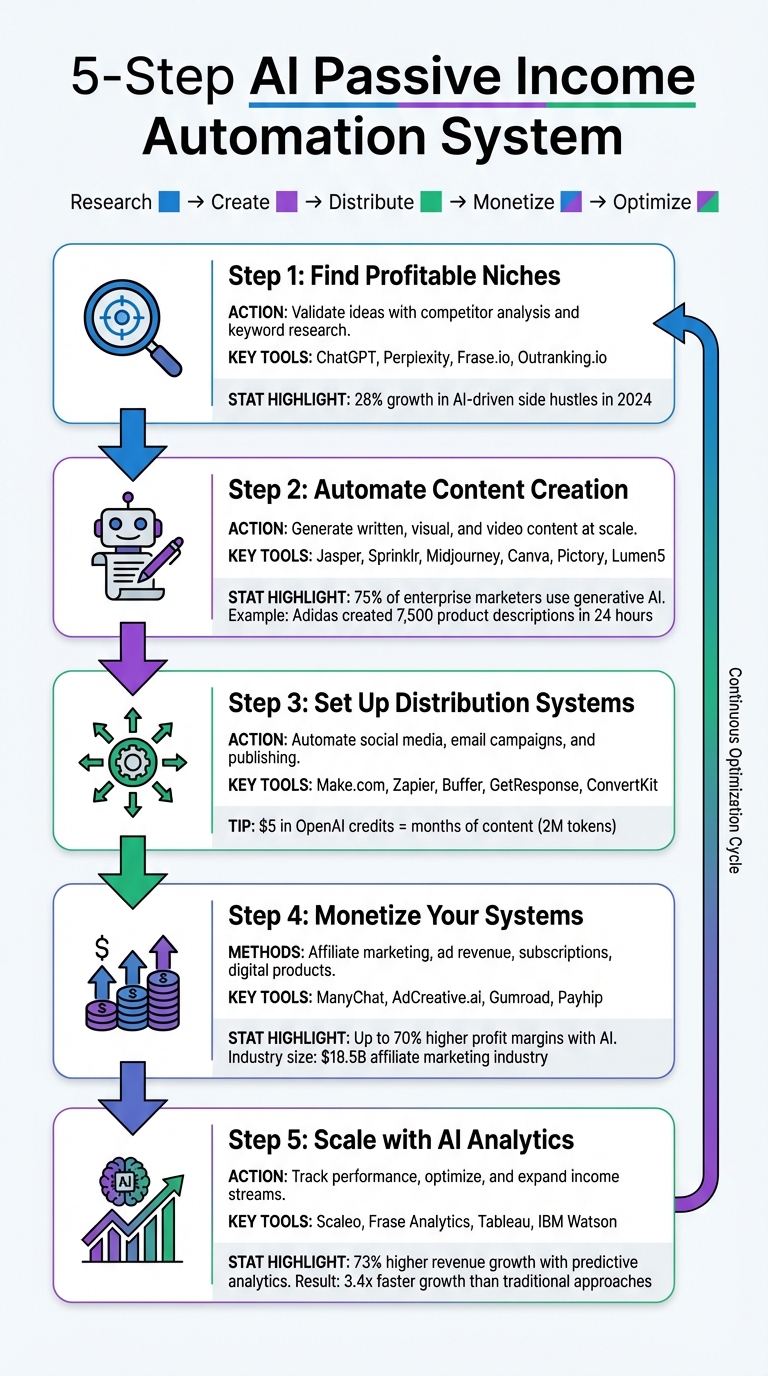
5-Step AI Passive Income Automation System
Step 1: Find Profitable Niches and Income Opportunities
How to Pick a Profitable Niche
When choosing a niche, don’t go too broad. Instead, aim for a micro-niche that solves specific problems for a targeted audience. For example, instead of focusing on "fitness", narrow it down to something like "printable meal planners for CrossFit moms." This approach helps you stand out in a less crowded market and directly addresses the needs of a particular group.
AI tools like ChatGPT and Perplexity can help you brainstorm niche ideas quickly. By using targeted prompts – such as "Give me five eBook niche ideas for busy parents" – you can generate ideas that align with market demands.
Keyword research is another area where AI shines. Tools like Frase.io and Outranking.io analyze search volume and competition, helping you identify keywords with low competition but high potential for profitability. Jeremiah Curvers, Co-founder and CEO of Polysleep, explains, "It’s very easy to build a keyword list based on competitiveness".
Another strategy is to look for content gaps – areas where there’s demand but limited supply. These underserved markets are perfect for AI-powered projects, giving you a chance to meet unmet needs effectively.
Use AI to Validate Your Ideas
Once you’ve identified a niche, use AI to validate its potential. Start with competitor analysis. For instance, you can prompt ChatGPT to "Identify the top three competitors in [your niche] and highlight their weaknesses." This analysis can uncover opportunities where competitors are falling short, allowing you to position yourself strategically.
You can also test demand before a full launch by creating a simple landing page. AI can assist with writing the copy, designing mockups, and even suggesting pricing based on competitor insights. This saves time and reduces upfront costs.
To stay ahead of the curve, monitor emerging trends using tools like BuzzSumo and Exploding Topics. These platforms can help you spot new opportunities early. For those exploring YouTube automation, tools like TubeBuddy and VidIQ provide AI-powered insights for optimizing video titles, tags, and thumbnails – helping you gauge audience interest before investing in content production.
The numbers speak for themselves: interest in AI-driven side hustles grew by 28% in 2024, with over 80,000 solo entrepreneurs launching AI-powered microbusinesses. The affiliate marketing industry alone is worth $18.5 billion, with over 80% of businesses involved. On top of that, AI-generated content businesses can achieve profit margins up to 70% higher than traditional ventures, thanks to reduced labor costs.
| Validation Step | AI Tool Example | Purpose |
|---|---|---|
| Ideation | ChatGPT, Jasper | Generate niche ideas tailored to specific needs |
| Market Research | BuzzSumo, Exploding Topics | Track trends and identify market gaps |
| Keyword Research | Frase.io, Outranking.io | Pinpoint low-competition, high-intent keywords |
| Competitor Analysis | Outranking.io | Uncover weaknesses in competitor strategies |
Step 2: Automate Content Creation with AI
Create Written Content with AI Tools
Using an AI tools list for writing has revolutionized the content creation process, covering everything from brainstorming ideas to publishing finished pieces. Tools like Jasper and Sprinklr simplify this workflow, even allowing a single blog post to be repurposed into 10–20 different pieces of content, such as social media posts, emails, and video scripts.
Maintaining brand consistency is no longer a hassle. Many AI platforms come with built-in "Brand Voice" features, ensuring your unique tone and style remain intact across all content. For instance, Adidas utilized Jasper to generate 7,500 product descriptions in just 24 hours, significantly speeding up their marketing timelines. Similarly, Cushman & Wakefield used Jasper to automate localized marketing materials, saving their teams an estimated 10,000+ hours annually. This initiative was spearheaded by Peter So, VP of Digital Innovation.
The adoption of AI in content creation is widespread – 75% of enterprise marketers are already leveraging generative AI tools for managing content. Platforms like Grammarly, used by over 40 million people, allow for instant adjustments to tone, formality, and length with just a click, eliminating the need for time-consuming manual edits. For social media, AI tools streamline workflows by optimizing character limits, suggesting platform-specific hashtags, and even adding emojis tailored to platforms like X (formerly Twitter), LinkedIn, and Instagram.
"Our marketing teams have cracked the code of using Jasper as an agentic partner in our day-to-day lives, transforming how we work, collaborate and evolve as an organization." – Elaina Shekhter, Chief Marketing & Strategy Officer
While AI takes care of written content, it’s equally game-changing when it comes to creating visuals.
Generate Images and Videos with AI
AI doesn’t just handle text – it’s also a powerhouse for scaling visual content. Brands focused on faceless video content, for example, can now operate without the need for constant physical presence. Tools like Pictory and Lumen5 transform text into videos using stock footage, while platforms like Synthesia create "talking head" videos without requiring a camera.
For image creation, platforms such as Midjourney and Canva Magic Studio are perfect for generating social media graphics, product mockups, and digital designs. The market for AI-driven digital products is booming, projected to reach $1.4 trillion by 2027, with creators reportedly earning ~$2,000 monthly from a $29 product.
A useful tip: follow the "70/30 rule." Dedicate 70% of your time to strategy and audience building, and only 30% to AI-assisted creation. Batch production is also key – set aside specific days to create multiple videos or images at once. This approach ensures a steady publishing schedule without the need for daily effort.
For those looking to dive deeper, Your Automated Life offers detailed guides on setting up faceless video workflows, enabling you to produce content on autopilot. However, always verify commercial licenses when using AI tools like Midjourney or Kittl to avoid copyright issues in your projects. To maintain visual consistency, develop standard prompt templates tailored to your niche. For example, you might use a prompt like, "Create a professional mockup for a [niche] planner".
| Tool Category | Recommended Platforms | Primary Function for Passive Income |
|---|---|---|
| Visual Design | Midjourney, Canva Magic Studio, Kittl | Creates social media graphics, product mockups, and POD designs |
| Video Creation | Pictory, Lumen5, Synthesia | Converts scripts into faceless YouTube videos or course content |
| Video Editing | Descript, OpusClip | Automates captions, adds B-roll, and repurposes content for short-form videos |
| Audio/Voice | ElevenLabs, Mubert | Produces voiceovers and background music for video projects |
Step 3: Set Up Automated Distribution Systems
Automate Social Media Posts and Email Campaigns
Once you’ve automated content creation using AI, the next step is streamlining how that content reaches your audience. Efficient distribution is key to maximizing your passive income potential. Using tools like Make.com and Zapier, you can connect content sources – such as Google Sheets or WordPress – to social media schedulers and email platforms, creating a seamless distribution system.
Here’s how it works: imagine a Google Sheet where each row contains a piece of content. Make.com can monitor this sheet, format the content for various platforms (e.g., adjusting for character limits, adding hashtags, or including emojis for Instagram or X), and schedule posts automatically. Similarly, Zapier’s "Trigger-Action" framework simplifies cross-platform sharing. For example, you can set it up so that when a new blog post is published, it’s instantly shared on LinkedIn and sent to your email list.
Many successful creators prioritize building this automated distribution system before producing content. This ensures everything functions smoothly from the start and reduces the risk of burnout. Platforms like Beehiiv, GetResponse, and ConvertKit also integrate AI to handle tasks like generating subject lines, drafting emails, creating welcome sequences, and running perpetual promotions.
"Automation applied to an inefficient operation will magnify the inefficiency." – Bill Gates
Here’s a helpful tip: initially, set your automations to save posts as drafts. This gives you time to review and make adjustments to ensure everything aligns with your standards. Once you’re confident in the system’s accuracy, you can switch to automatic publishing.
After setting up social and email automation, the next step is to automate content publishing and file organization for a fully integrated system.
Automate Content Publishing and File Management
Take automation a step further by streamlining blog publishing, YouTube uploads, and file management. For WordPress users, the Make Connector plugin can link Make.com to your site, enabling automated workflows that publish posts directly – either as drafts or live articles. You could even schedule Make.com to run every 15 minutes, pulling data from a Google Sheet, generating content with OpenAI, and publishing it to your blog.
For video creators, tools like VidIQ and TubeBuddy simplify the process by optimizing titles, descriptions, and tags during uploads, ensuring your videos are optimized for search engines. Combine these with tools like OpusClip or Pictory, which extract shareable clips from long-form videos and distribute them to TikTok, Instagram Reels, and YouTube Shorts. This creates a fully automated video distribution pipeline.
File management can also run on autopilot. Use platforms like Airtable to store content ideas, subject lines, and attachments in one place. By connecting Airtable to Zapier, you can ensure that research links or email attachments are automatically saved into your database, eliminating manual organization.
| Tool Category | Recommended Platforms | Role in Distribution |
|---|---|---|
| Workflow Connectors | Zapier, Make.com | Links apps and triggers automated tasks |
| Social Scheduling | Tailwind, Buffer, ManyChat | Automates post timing and audience engagement |
| Email Automation | GetResponse, Beehiiv, ConvertKit | Manages automated sequences and newsletters |
| Video Distribution | Pictory, OpusClip, Descript | Converts text to video and automates uploads |
| SEO & Analytics | VidIQ, TubeBuddy | Automates keyword targeting and performance tracking |
With just $5 in OpenAI API credits, you can generate enough content to last for months – roughly 2 million tokens’ worth. Make.com even offers a free tier, making it a great starting point for beginners. For those who need guidance, Your Automated Life provides ready-to-use workflows, so you don’t have to tackle the technical setup alone.
100% Automated: Passive Income with Kling AI Video and Make.com
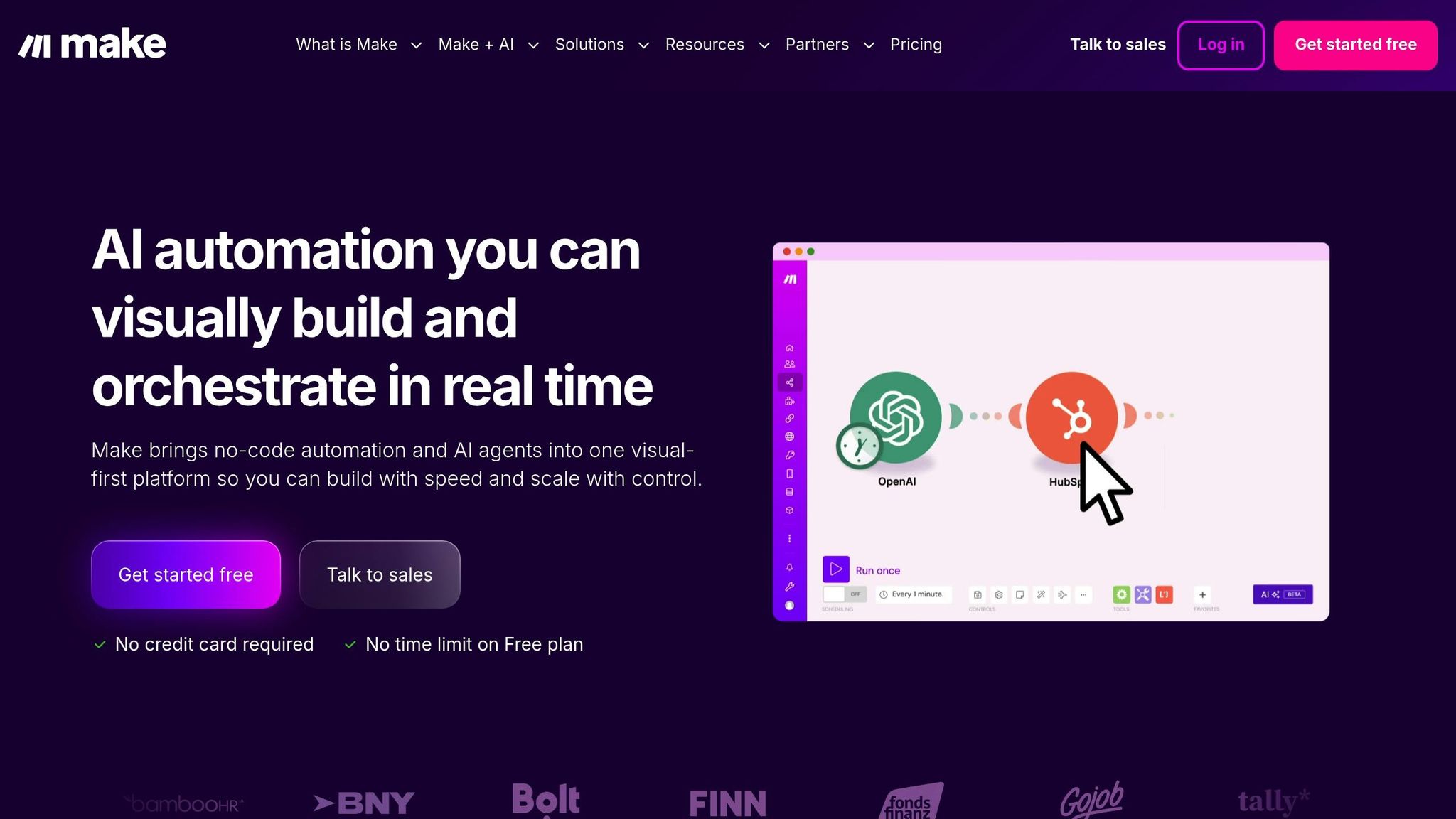
This setup is a perfect example of how to build passive income with AI tools from scratch.
sbb-itb-4bfa3ba
Step 4: Monetize Your Automated Systems
Once you’ve automated your content creation and distribution, the next step is turning that traffic into revenue. AI doesn’t just streamline content production – it can also handle monetization tasks, from spotting opportunities to managing sales processes.
Set Up Affiliate Marketing and Ad Revenue
AI simplifies affiliate marketing by automating tasks like niche research, creating SEO-focused content, and distributing it across multiple platforms. The trick lies in targeting transactional keywords – phrases like "best AI tools for" or "top software vs" – that indicate a strong intent to buy and tend to convert more effectively. Tools such as Frase.io and Outranking.io can analyze competitor strategies, uncover content gaps, and help your articles rank faster in search results.
AI-powered systems can also build automated affiliate funnels. These include generating landing page copy, designing lead magnets, and creating email sequences that nurture leads and drive commissions – all without requiring manual effort. For example, ManyChat can deploy AI chatbots to capture leads and recommend affiliate products around the clock. Similarly, AdCreative.ai can create high-performing social media visuals automatically.
The rise of "faceless brands" has made affiliate marketing even more accessible. Using tools like Pictory and InVideo, creators can produce scripts, voiceovers, and B-roll for platforms like TikTok and YouTube – promoting affiliate products without ever appearing on camera. This approach is scalable and less labor-intensive, allowing creators to target multiple niches simultaneously.
"AI isn’t here to replace us; it’s here to enhance our capabilities and increase our opportunities for earning passive income." – Douglas Lampi
One smart move is to prioritize recurring commission programs, such as SaaS or AI tools that offer monthly payouts instead of one-time commissions. This strategy creates a steady, compounding income stream. Many creators also embed affiliate links into AI-generated digital products like Notion templates or prompt packs, stacking multiple income streams into a "hybrid monetization" model.
For ad revenue, AI-driven businesses scale operations about 3.4 times faster than traditional setups. Companies that incorporate predictive analytics into their automation systems report 73% higher revenue growth compared to those using basic automation. Tools like ChatGPT can analyze data from platforms like Google Analytics or affiliate dashboards, helping you identify which content generates the most profit so you can double down on successful strategies.
| AI Tool Category | Specific Tools | Role in Monetization |
|---|---|---|
| Content & Copy | Rytr, Jasper, ChatGPT | Writing reviews, blog posts, and email sequences |
| SEO & Research | Frase.io, Outranking.io | Keyword research, SERP analysis, and content gap identification |
| Visuals & Ads | AdCreative.ai, Canva AI | Designing social media ads and high-converting graphics |
| Lead Capture | ManyChat | Automating chatbots for 24/7 lead generation |
Sell Subscriptions and Digital Products
Affiliate marketing is a great start, but adding digital products to your mix can take your income to the next level.
Digital products and subscriptions offer high profit margins, with AI-based businesses often achieving profit margins up to 70% higher than traditional content operations due to reduced labor costs. The key is building a revenue funnel – combining a product, automated delivery system, and traffic plan.
AI can help you pinpoint pain points in your niche and create solutions in the form of digital products. Instead of selling generic items like "50 prompts", focus on the outcome: "Generate a complete 7-day email sequence in 20 minutes". By emphasizing results, you can charge higher prices and boost conversion rates. Platforms like Gumroad, Payhip, and Whop make it easy to handle payments and deliver products instantly.
A value ladder is an effective structure for monetization, offering multiple pricing tiers: free lead magnets to collect emails, low-priced toolkits ($7–$49), mid-priced systems ($99–$499), and high-ticket items like consulting or memberships. For example, AI-powered subscription services often retain customers for an average of 14 months, creating consistent recurring revenue.
To automate this process, tools like GetResponse, Beehiiv, or ConvertKit can set up email sequences that nurture leads into paying customers without requiring manual follow-up. Before fully committing to a product idea, you can use AI to create a simple landing page and test demand – saving time and resources.
The "prompt-product flywheel" is a powerful framework for creating a self-sustaining system. AI can be used sequentially for research (identifying problems), content creation (building authority), product drafting (outlines and lessons), marketing (sales copy), and automation (delivery and upsells). Each step feeds into the next, creating a seamless cycle.
"Passive income still requires active design thinking – systems, validation, user testing, and brand clarity. GPT gives you leverage, not guarantees." – Time Money Code
Your Automated Life provides ready-made workflows and detailed guides to simplify the technical aspects of setting up these systems. Instead of figuring everything out yourself, you can follow proven frameworks and start generating revenue sooner.
Step 5: Scale and Optimize with AI Analytics
Once your automated monetization system is up and running, AI analytics can take things to the next level by refining your strategy and scaling your revenue. These tools deliver real-time insights to help you make smarter, faster decisions. For example, platforms like Scaleo track affiliate performance, Frase Analytics monitors SEO metrics, and tools like Tableau and IBM Watson visualize customer behavior trends – all of which enable data-driven adjustments to your strategy.
Track Performance with AI Analytics Tools
Predictive analytics is a game-changer when it comes to anticipating sales trends and shifts in consumer behavior. Businesses that integrate predictive analytics into their automation systems have reported 73% higher revenue growth compared to those relying on simpler automation tools. This allows you to stay ahead of the curve, tweaking your content strategy or pricing models before market changes can negatively impact your earnings.
AI tools like ChatGPT can further simplify the process by converting complex dashboards into plain-English summaries, making it easier to identify profit drivers. Tracking key metrics – such as recurring commission trends, email open rates, and keyword rankings – helps pinpoint what’s working and where improvements are needed. These insights lay the groundwork for optimizing and scaling your passive income systems.
"Automation applied to an inefficient operation will magnify the inefficiency." – Bill Gates
Another effective tactic is to implement feedback loop systems. Here’s how it works: customer interactions feed directly into your analytics, driving improvements in future offerings. For example, if data reveals that a specific email subject line underperforms, the system can flag it for revision or automatically test alternative versions. Over time, this creates a self-improving cycle that boosts conversion rates.
Expand Your Income Streams with AI
Armed with performance metrics, you can confidently scale your strategies. AI makes it easy to repurpose high-performing content into multiple formats, a process known as fractional content recycling. For instance, a successful blog post can be transformed into YouTube videos, social media updates, and email snippets – maximizing its reach without requiring you to start from scratch. Automated YouTube channels using this approach have been shown to attract three times more subscribers compared to manually managed ones.
Diversifying your income streams is another smart move for long-term stability. If you run an affiliate site, consider branching out into automated video content or launching a subscription-based digital product. AI-generated content businesses often achieve profit margins up to 70% higher than traditional models, thanks to significantly reduced labor costs.
AI can also help with pricing strategies. Algorithmic price optimization allows AI to continuously refine pricing for digital products or subscription services, ensuring you maximize revenue. Some creators even use AI-powered investment tools like Wealthfront or Betterment to automatically reinvest their passive income earnings for additional growth.
Sustainable growth depends on monitoring efficiency metrics, such as the time saved by automation and how your cost per unit decreases as volume increases. Interest in AI-powered side hustles grew by 28% in 2024, with 43% of users reporting that AI significantly boosted their productivity. By focusing on impactful optimizations and letting AI handle repetitive tasks, you can scale your income streams without increasing your workload.
| Metric | AI Tool | Why It Matters |
|---|---|---|
| Affiliate CTR & Conversions | Scaleo | Identifies top-performing links and products |
| SEO Rankings & Traffic | Frase Analytics, Ahrefs | Spots content gaps and optimization opportunities |
| Email Campaign Performance | GetResponse, ConvertKit | Refines automated nurture sequences |
| Sales Forecasts | IBM Watson, Tableau | Anticipates market shifts before they affect revenue |
Conclusion
Key Takeaways
Creating an AI-powered passive income system boils down to five key steps. First, pinpoint a niche with profit potential by using AI tools to validate demand before committing your time and energy. Next, automate your content creation process – transforming one core idea into multiple formats with AI tools for writing, images, and videos. Then, establish automated distribution systems to handle tasks like social media posting, email campaigns, and content publishing, freeing you from daily involvement. After that, integrate monetization strategies such as affiliate links, ad revenue, subscription models, or digital products that sell automatically. Finally, use AI-driven analytics to monitor performance, refine weaker areas, and expand into additional income streams.
The core principle here is automation. It’s what separates a sustainable system from a side hustle that leads to burnout. As highlighted throughout this guide, the foundation – automated posting, scheduling, and delivery – should be in place before you even create your first piece of content. AI-driven systems grow 3.4 times faster than traditional approaches, and digital assets built this way can generate ongoing revenue long after they’re set up. These steps can transform your process into a self-sustaining income engine.
"AI won’t save you – but it can scale you." – David Reid, Founder of Infinite Hustle Lab
By combining AI tools with automated workflows and sticking to a consistent plan, you can create a system that earns money 24/7 without demanding constant oversight.
Get Started with Your Automated Life
It’s time to take action. To turn these ideas into tangible results, follow a structured blueprint. Your Automated Life provides everything you need to shift from manual effort to fully automated income systems. Their 6-step framework includes picking a niche, building a simple platform, setting up the automation backbone, creating a core content asset, repurposing it across multiple channels, and adding monetization. The platform also offers detailed guides for five AI-powered models: niche websites, automated newsletters, faceless video brands, digital product stores, and affiliate funnels – each designed to operate with minimal daily input.
The resources available include ready-to-use workflows that connect tools like ChatGPT, Zapier, and Canva into seamless automated systems. Whether you start with their free guide featuring 10 pre-built automations or dive into premium content for advanced strategies, the goal remains clear: build it once, and let it work for you continuously. Visit Your Automated Life to access tools, guides, and templates that can help you launch your first passive income system – or take your existing one to the next level.
FAQs
How does AI help find profitable niches for building passive income?
AI simplifies the process of finding profitable niches by sifting through vast amounts of data in mere seconds. By inputting details about your skills, interests, or target topics, these tools can analyze search trends, competition, and revenue potential to pinpoint areas where demand exceeds supply. This allows you to focus on niches that are not only financially promising but also personally engaging.
For instance, AI can evaluate metrics like search volume, competition levels, and earning potential to suggest niche ideas such as "ergonomic home-office setups for remote workers" or "budget-friendly meal planning for families." Beyond identifying niches, AI can recommend ways to monetize them, including affiliate marketing, selling digital products, or offering subscription-based services. With tailored prompts and efficient workflows, you can seamlessly transition from niche selection to creating a scalable income stream.
What are the best AI tools to streamline content creation and distribution?
AI tools can streamline every stage of the content process, from coming up with ideas to sharing them with your audience. For content creation, tools like ChatGPT and Jasper can draft blog posts, newsletters, or video scripts in no time. Meanwhile, platforms like Opus Clip and Notebook LM are perfect for creating visuals and short-form videos designed for multiple platforms. These tools not only save time but also help produce content that looks polished and grabs attention.
On the distribution side, automation tools like Zapier and Make let you seamlessly connect your content to email services, social media schedulers, and other platforms – no coding required. Email marketing tools such as ConvertKit can automatically send AI-generated newsletters and launch campaigns, while AI-powered analytics tools help fine-tune your posting schedules and monitor performance. By combining these tools, you can easily expand your content strategy with less effort.
How can AI help optimize and grow passive income systems?
AI takes the complexity out of managing passive income systems by analyzing performance data – like click-through rates, conversions, and engagement – and transforming it into practical strategies. It pinpoints what’s working, such as top-performing keywords or successful ad campaigns, and automatically adjusts approaches to deliver better results, saving both time and effort.
Through real-time analysis, AI can continuously run A/B tests, spot emerging trends, and refine campaigns in just minutes. It can also predict demand, recommend the best posting times, and even suggest content ideas aimed at increasing conversions. This empowers entrepreneurs to grow their income streams more effectively – whether by diving into new niches or optimizing current ones – without needing to spend hours on management.