
Yes, AI can help generate passive income, but it requires upfront work. Here’s the deal: AI simplifies tasks like content creation, market research, and automation, making it easier to maintain income-generating systems. However, it’s not a "set it and forget it" solution. You’ll need to invest time in selecting a niche, building digital systems, and creating quality content before AI can take over repetitive tasks.
Here’s what you need to know:
- Passive income isn’t instant. Most systems take 4–6 months to start earning ($100–$500/month) and can grow to $2,000+ per month after a year.
- AI tools save time. They automate tasks like social media scheduling, content repurposing, and email marketing, reducing manual work by 29%.
- Popular methods include:
- Affiliate marketing (earning commissions through AI-generated content).
- Faceless YouTube channels (using AI for scripts, voiceovers, and videos).
- Automated email newsletters (monetized through subscriptions, sponsorships, and affiliate links).
AI helps streamline workflows, but success depends on consistent effort, smart niche selection, and quality content. Start small, fine-tune your systems, and expand over time.
What Is Passive Income and How Does AI Fit In?
Understanding Passive Income
Passive income isn’t about sitting back and magically watching money roll in – that’s a myth. Instead, it’s about creating systems or digital assets that generate revenue with minimal ongoing effort after you’ve done the initial heavy lifting. Unlike active income, which stops the moment you stop working (think freelancers or hourly workers), passive income is designed to keep flowing – whether you’re sleeping, traveling, or working on something else. The key difference? It still requires significant upfront effort to set up.
By 2025, over 80,000 solo entrepreneurs have launched AI-powered microbusinesses. This shift highlights how AI is transforming passive income strategies. AI now acts as the automation engine, taking over repetitive tasks that once required constant manual input. Let’s take a closer look at how AI simplifies these processes.
How AI Automation Works
AI takes over tasks like content creation, graphic design, market research, and social media scheduling. This frees creators to spend more time on strategy and building their audience. In fact, many now dedicate about 70% of their time to strategic planning, leaving just 30% for content creation, with AI handling most of the workload.
Here are some real-world examples of AI-powered workflows:
- Affiliate Marketing Automation: AI simplifies program selection, conducts keyword research, and generates SEO-friendly reviews.
- Faceless YouTube Channels: AI creates scripts, voiceovers, and videos, eliminating the need for cameras or advanced editing skills.
- Automated Email Newsletters: AI curates content, writes subject lines, segments audiences, and manages delivery.
AI automation doesn’t just save time – it boosts efficiency. Studies show it can reduce weekly work hours by 29%, with 43% of side hustlers reporting increased productivity. For instance, content creator Noah Morris operates seven YouTube channels using AI for scripting and editing, earning $1.2 million annually from ads and sponsorships. Similarly, an Etsy seller used AI to design digital papers and textures, racking up over $315,000 in sales by 2024.
Does AI Create Instant Income or Require Setup Work?
The Setup Phase: What to Expect
AI isn’t a magical money-making machine that churns out cash overnight. To build a sustainable income stream with AI, you need to invest time and effort upfront to set up the systems that will eventually run on autopilot.
The first step? Choosing your niche. It’s essential to get specific here. Instead of targeting broad categories like "fitness", narrow it down to something like "printable meal planners for CrossFit moms." This micro-niche approach helps you carve out space in less crowded markets. Once you’ve nailed your niche, the next task is creating your platform. Whether it’s a WordPress site, an email newsletter via Beehiiv, or a faceless YouTube channel, this is where your audience will engage with your content. You’ll also need to establish an automation system to handle tasks like auto-posting to social media, scheduling content, and delivering digital products – all without your constant supervision.
Next comes the heavy lifting: creating your core assets. This usually starts with a "seed" piece of content, like a detailed blog post or a well-researched video script. From there, AI can repurpose that single piece into 10–20 additional formats, such as social media snippets, email newsletters, or infographics. Finally, you’ll link everything to monetization options like affiliate programs with recurring commissions or platforms like Gumroad or Payhip for selling digital products.
Here’s a general timeline for income growth: $0–$100 during months 1–3, $100–$500 in months 4–6, and $500–$2,000 by months 7–12. Don’t expect immediate results – building trust with your audience and gaining SEO authority takes time, and income typically starts to trickle in around the 4-to-6-month mark.
Once your setup is complete, AI takes over the repetitive tasks, allowing you to focus on growing your audience and refining your strategy.
How AI Reduces Ongoing Work
After the initial setup, AI becomes your behind-the-scenes powerhouse, automating tasks and keeping your systems running smoothly. Think of it as your tireless digital assistant, working around the clock.
One of AI’s standout strengths is its ability to repurpose content. For example, a single blog post can be transformed into 10–20 different formats, including video scripts, social media posts, email newsletters, and infographics – all without you having to start from scratch. AI tools also handle the scheduling and publishing of this content across various platforms, ensuring consistent distribution. For digital products, AI-powered platforms can instantly deliver items like eBooks or lead magnets to customers.
Email workflows are another area where AI shines. Tools like GetResponse or Beehiiv can automate entire campaigns, while chatbots such as ManyChat manage lead generation, answer FAQs, and provide basic customer support 24/7. Even data analysis gets a boost – AI tools can break down complex analytics from Google or affiliate dashboards into simple, actionable insights, saving you the effort of manual number-crunching.
The result? You can dedicate about 70% of your time to strategy and audience engagement, leaving AI to handle the remaining 30% of content production and operational tasks.
| Automation Category | AI Tools Example | Tasks Automated |
|---|---|---|
| Content Creation | ChatGPT, Claude, Jasper | Writing, brainstorming, and drafting |
| Visuals/Video | Midjourney, Pictory, OpusClip | Graphic design and video editing |
| Marketing | AdCreative.ai, GetResponse | Ad generation and email sequences |
| Operations | Zapier, Make.com | Data syncing and workflow triggers |
| SEO | Frase.io, Outranking.io | Keyword research and content optimization |
I Ranked Every AI Side Hustle (Here’s What’s ACTUALLY Good)
Common AI-Powered Passive Income Methods
Now that you know how AI can lighten your workload, let’s dive into three popular ways to generate passive income using AI automation. Each method comes with its own perks, and many creators mix and match these strategies to diversify their earnings.
Affiliate Marketing Automation
Affiliate marketing is a massive industry – currently worth $18.5 billion – with over 80% of businesses taking part in it. AI makes affiliate marketing easier by handling tasks like product selection, keyword research, and content creation. For instance, AI writing tools can churn out SEO-friendly product reviews, comparisons, and tutorials, saving you from spending hours on manual drafting. To maximize your results, focus on keywords that drive conversions, such as phrases including "best", "top", or "vs".
One powerful strategy is setting up an "Affiliate Funnel." Picture this: a blog post directs readers to an AI-generated email series, which then leads them to a product review, earning you commissions along the way. Tools like Wati can automate sharing affiliate links and even answer customer questions on your site. Meanwhile, AI-powered analytics track your sales and customer behavior in real time, helping you fine-tune your strategy.
Here’s a real-world example: Oak Furniture Superstore saw an 85% increase in orders after using AI for affiliate selection and market expansion. Similarly, a travel affiliate program boosted its campaign ROI by 30% in just six months by incorporating AI-driven predictive analytics. Recurring commissions are a game-changer here – promoting AI tools or SaaS platforms that offer monthly subscriptions can build steady income. Some creators using AI-assisted content report earning between $3,000 and $5,000 per month, while marketers have seen their annual income grow by an average of 50% through these methods.
Next, let’s explore how faceless YouTube channels can tap into similar automation benefits for revenue generation.
Faceless YouTube Channels
Faceless YouTube channels allow you to earn money without ever appearing on camera. AI takes care of the heavy lifting – writing scripts, generating voiceovers, creating visuals, and even designing thumbnails.
Start by choosing a high-paying niche, like finance or technology, to maximize ad revenue. Tools like ChatGPT or Claude can help you draft detailed scripts, complete with timestamps and scene suggestions. For voiceovers, advanced tools like ElevenLabs can provide natural-sounding narration, steering clear of robotic tones that might turn viewers away. Video creation platforms like Pictory, Lumen5, or RunwayML can transform your scripts into polished videos, while AI image generators like Midjourney or DALL-E can craft eye-catching thumbnails designed to boost click-through rates.
Success hinges on watch time. For example, a video with 1.2 million views and an average watch time of 20 minutes can bring in around $21,000. Channels with longer retention rates get more ad placements, which means more revenue. One faceless celebrity-news channel earned a staggering $60,000 in a single month after hitting 6 million views.
"The formula is simple: longer videos + higher retention = more ads = more revenue." – Esha Usmani
With AI-powered tools, it’s possible to earn over $104,000 annually from a YouTube channel. To stay productive without burning out, try batch-producing 4–6 videos in one session. You can also repurpose long-form videos into short clips using tools like OpusClip, which are perfect for YouTube Shorts and can expand your reach.
Now, let’s look at how AI can streamline email newsletters into a steady income source.
Automated Email Newsletters
AI also makes email newsletters a breeze to create and monetize. These newsletters are an excellent way to connect directly with your audience and build a consistent revenue stream.
Platforms like Beehiiv and ConvertKit use AI to handle growth, analytics, and monetization. Even a small newsletter with just 1,000 subscribers can generate between $3,000 and $5,000 per month through a mix of revenue streams. By using AI-driven segmentation and personalization, some newsletters earn 3 to 5 times more revenue per subscriber.
Take The AI Advantage Newsletter as an example. Launched in January 2024, it grew to 9,781 subscribers by December of the same year. By its 12th month, it was generating $13,640 in monthly revenue: $6,240 from 428 paid subscribers, $3,500 from sponsorships, $2,150 from affiliate links, and $1,750 from digital products. Initially requiring 15 hours per week, the time commitment dropped to just 5 hours per week thanks to automation.
"Using AI for content creation isn’t about replacing human expertise – it’s about amplifying it." – IncomePill Team
To make the most of your time, follow the 60/40 Rule: let AI handle 60% of the work (like research, outlines, and initial drafts) while you focus on the remaining 40% (adding personal insights, expert opinions, and final touches). Stick to topics with high information gaps, such as finance, AI tools, or professional skills, where AI can effectively compile and simplify complex data. You can also boost your income by combining premium subscription tiers ($5–$50/month), affiliate links, and digital products like templates or guides. Tools like Zapier or Make.com can automate tasks like subscriber updates, social media cross-posting, and lead magnet delivery. With AI assistance, high-value lead magnets can achieve conversion rates as high as 43%, well above the industry average of 15–25%.
sbb-itb-4bfa3ba
Common Challenges with AI-Powered Passive Income
While AI can simplify the journey to passive income, it doesn’t come without obstacles. Recognizing these challenges early on can save you time and frustration. These hurdles often align with earlier insights on AI automation, shedding light on common mistakes that can limit your growth.
Choosing a Profitable Niche
A frequent misstep for beginners is chasing trendy topics instead of focusing on areas where they have expertise or genuine interest. It’s easy to be drawn to hot markets like cryptocurrency or weight loss because they seem lucrative, but if you lack knowledge or passion, your content may feel forced or insincere. This often results in low engagement and disappointing sales.
Finding the right niche is crucial for long-term success. Another common trap is choosing a niche that’s either too broad or too narrow. For example, tackling a massive category like "health and wellness" means competing with well-established brands. The sweet spot lies at the intersection of what you know, what people are willing to pay for, and what you can sustain over time.
"The biggest success stories I’ve seen come from people who use AI to amplify their existing knowledge and interests, not from people trying to create content about topics they know nothing about." – Guides Grid
A good rule of thumb is the "Dinner Party Test": choose a topic you’d naturally talk about with enthusiasm. If you can’t see yourself discussing it effortlessly, you’re likely to lose interest before it generates meaningful income. To confirm there’s demand, explore YouTube for popular videos on related keywords, browse Amazon for relevant products, and check forums like Reddit or Quora for recurring questions. Prioritize keywords with commercial intent – terms like "best", "top", or "for [specific audience]" – which tend to drive higher affiliate conversions.
It’s also important to set realistic expectations. Most AI-powered ventures generate $0–$100 in the first three months, growing to $500–$2,000 per month by months 7–12. By the second year, those who scale effectively can reach $2,000–$10,000+ per month. Successful creators typically dedicate 70% of their time to strategy and audience building and only 30% to content creation.
Maintaining Content Quality
Once you’ve settled on a niche, the next challenge is ensuring your content maintains a high standard. While AI can produce content quickly, over-reliance on it can hurt quality. Publishing AI-generated material without proper editing risks losing credibility. AI should be viewed as a tool for drafting or research, not a substitute for your unique voice and insights.
"AI delivers raw speed and initial draft capability; you deliver the critical quality control, strategic refinement, brand alignment, and essential human touch." – Mystic, LearnAItoprofit.com
Always review AI-generated content before publishing. AI tools can make factual errors or generate misleading information, often referred to as "hallucinations." To avoid the generic feel of AI-produced content, add a personal touch – whether through custom examples, personal notes, or expert commentary. Relying solely on AI for mass-produced, low-quality content can violate platform guidelines and hurt your long-term visibility.
Analytics can help you refine your approach. Monitor metrics like click-through rates, conversions, and audience feedback. If a particular AI-generated format isn’t resonating, experiment with new prompts or editing techniques. Keep your content fresh by regularly updating your prompts and tailoring them to trends in your niche. Transparency also matters – be upfront about using AI and focus on delivering value over self-promotion.
Promoting Your AI-Generated Content
Even the best AI-generated content won’t generate income if it doesn’t reach the right audience. Effective promotion is crucial for visibility and, ultimately, success.
To build a sustainable income stream, adopt a diverse traffic strategy. Combine SEO, social media, and email marketing to drive consistent traffic from multiple sources. While content repurposing helps extend the life of your material, promotion focuses on strategic distribution – reaching the right audience through paid ads, collaborations, and community engagement. This approach allows AI-generated content to generate revenue for months or even years with minimal maintenance.
Focus your promotional efforts on transactional keywords – those with commercial intent, such as "best", "top", or "for [specific audience]" – as they tend to convert well for affiliate offers. Use AI tools to identify low-competition, high-conversion keywords and optimize your content based on real-time search data. Automated email sequences, like welcome series or nurture campaigns, can also effectively promote affiliate links or digital products with minimal ongoing effort.
To maintain trust with your audience, aim to provide value 90% of the time and reserve promotions for the remaining 10%. Streamline your workflow by batching content creation – spend one day a week generating multiple pieces using AI, then schedule them for consistent distribution throughout the week. AI chatbots can also help capture leads and answer customer questions around the clock, guiding them through the sales funnel automatically.
When done right, a well-executed promotion strategy ensures your AI-driven content achieves its full earning potential.
Comparing Different AI Income Methods
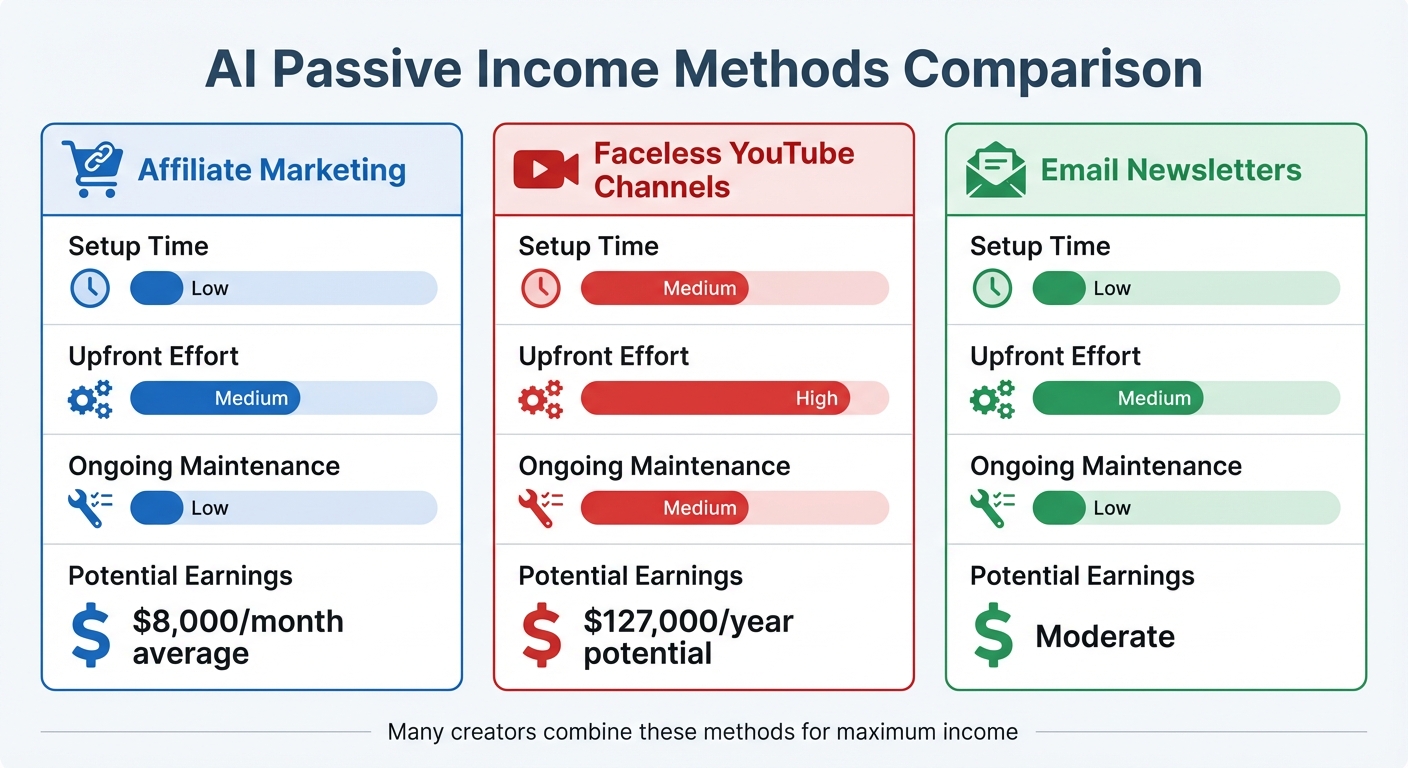
AI Passive Income Methods Comparison: Setup Time, Effort, and Earnings Potential
This section dives into the differences among several AI-driven income strategies, focusing on the time, effort, and earnings they demand. Each method has its own balance of upfront investment, ongoing work, and income potential.
Affiliate Marketing is often the simplest place to start. Here, you promote existing products – like AI tools or SaaS platforms – and earn a commission for sign-ups. All you need is a basic online presence, and AI tools can streamline tasks like keyword research and SEO content writing. On average, affiliate marketers earn around $8,000 per month.
Faceless YouTube Channels require more effort upfront but offer significant growth opportunities. By using AI tools for tasks like scripting, voiceovers, and video production, you can scale faster. Although the learning curve may be steep, automated YouTube channels can bring in about $127,000 in their first year – compared to $18,000 for manually run channels – and attract subscribers three times faster.
Automated Email Newsletters strike a middle ground. Platforms like Beehiiv and ConvertKit, paired with AI for generating ideas, writing drafts, and crafting subject lines, make setup relatively quick. Automation also handles delivery and lead nurturing. While earnings are typically moderate, newsletters shine in creating long-term, recurring income through consistent sponsorship deals.
AI Income Strategies Comparison
| Strategy | Setup Time | Upfront Effort | Ongoing Maintenance | Potential Earnings |
|---|---|---|---|---|
| Affiliate Marketing | Low | Medium | Low | Moderate ($8,000/month avg) |
| Faceless YouTube | Medium | High | Medium | High ($127,000/year potential) |
| Email Newsletters | Low | Medium | Low | Moderate |
Many creators successfully combine these methods to maximize income from a single asset. For instance, you could include affiliate links in a newsletter or use a YouTube channel to drive email sign-ups. This "monetization stacking" strategy allows you to diversify revenue streams without creating entirely separate systems. By blending these approaches, you can increase earnings while keeping your workload manageable.
How to Start Building AI-Powered Passive Income
Before diving into an AI-powered side hustle, it’s crucial to set up your automation systems. Why? Because these systems ensure your venture stays efficient and doesn’t morph into a full-time job. Think auto-posting to social media, auto-scheduling content, and auto-delivering lead magnets – all working seamlessly to keep your operations running 24/7.
Start by picking an evergreen topic where AI can bridge knowledge gaps. Topics like personal finance, productivity, AI tools, and fitness often stay relevant over time. Once you’ve chosen your niche, narrow your focus and create one core content asset – like a detailed blog post. This core piece can then be transformed into 10–20 smaller content pieces with the help of AI. This approach maximizes your content’s reach without requiring constant brainstorming.
Affiliate marketing is a great entry point, as it bypasses the need for product development and customer support. Focus on promoting AI tools that offer recurring monthly commissions instead of one-time payouts. Tools like ChatGPT or Claude can handle content creation, while no-code platforms such as Zapier or Make.com can link your lead magnet forms to automated email sequences – no coding required. With your niche and affiliate strategy in place, use no-code automation tools to streamline everything.
No-Code Automation Tools
You don’t need to be a tech wizard to build these systems. No-code platforms make it easy to connect apps and automate workflows. For instance, you can set up systems that automatically post new blog content to social media, deliver lead magnets to subscribers, or trigger email sequences based on user actions.
Set aside one day each week for batch content creation. Use AI to generate 4–6 pieces of content, creating a backlog that scheduling tools can distribute automatically. This frees up your time to focus on strategy and growing your audience – something successful creators reportedly dedicate about 70% of their efforts to.
Your Automated Life Resources
Once your automation systems are in place, you can tap into resources designed to fast-track your success. Your Automated Life offers beginner-friendly workflows that eliminate the technical learning curve. Their free starter guide includes 10 ready-to-use automations for content creation, email systems, and affiliate marketing. For those looking to go further, the AI Income Stack ($19.00) outlines 5 proven income models, while the AI Money Machine Toolkit ($49.99) provides a comprehensive plan for monetizing automation.
"Start a side hustle that is: Mostly automated, Mostly digital, System-based, Faceless (optional), Scalable, Built with minimal ongoing work." – Your Automated Life
With the automated revenue market projected to hit $1.4 trillion by 2027, now’s the perfect time to build your systems before the space gets saturated. Begin with one income model, fine-tune your automation, and expand into additional streams once you’ve validated your approach.
Conclusion
AI can help create passive income – but it requires upfront effort to establish reliable systems. As Andy Feliciotti and Ryan Robinson highlight:
"A lot of upfront work needs to go into a truly long-term sustainable passive income system".
Once these systems are in place, AI can efficiently handle routine tasks across different income streams. Whether it’s affiliate funnels, faceless YouTube channels, or automated newsletters, the key lies in setting up these systems strategically.
Here’s a simple formula: AI Tools + Digital Systems + Consistency = Results. From automating affiliate marketing to building email sequences or running faceless YouTube channels, the approach remains the same: start small and scale up as you go. In 2024, 43% of side hustlers reported that AI tools significantly improved their productivity. Additionally, with over 80,000 solo entrepreneurs launching AI-powered microbusinesses in 2025, it’s clear that the entry barrier is lower than ever.
The process is straightforward: pick one income model, test it, and then expand. Use AI to batch content, repurpose it across platforms, and keep a human touch to ensure quality and trustworthiness. AI should amplify your skills while keeping your unique voice intact. The entrepreneurs finding real success aren’t just using AI – they’re building scalable systems that generate income even when they’re not actively working.
Ready to get started? Grab your free starter guide from Your Automated Life and check out the AI Income Stack ($19.00) or the AI Money Machine Toolkit ($49.99) for step-by-step guidance. These beginner-friendly tools combine the strategies covered in this article to help you build sustainable passive income. There’s no better time to dive in before the space becomes crowded.
FAQs
How do I choose the best niche for building AI-powered passive income?
Choosing the right niche is a crucial step in building a successful AI-powered passive income stream. Start by identifying topics you’re genuinely interested in or have some expertise in – think fitness, personal finance, parenting, or even specific hobbies. Once you have a few ideas, leverage AI tools to conduct market research. These tools can help you analyze search trends, keyword demand, and competition levels, making it easier to spot niches that have high interest but manageable competition. These are often the sweet spots for growth.
After narrowing down your options, evaluate how well the niche aligns with monetization strategies that AI can help streamline. For instance, if affiliate marketing catches your eye, look for products or services that offer solid commission rates and provide easy-to-track affiliate links. If digital products are more appealing, use AI to brainstorm and outline ideas such as e-books, templates, or online courses. To gauge earning potential, review common price ranges – say, $20 to $50 per product – and run small-scale tests to see if there’s real demand.
By combining your passions with AI-driven insights, you can confidently choose a niche that’s not only scalable but also capable of generating sustainable income over time.
How can I start using AI to create passive income?
Getting started with AI to generate passive income can be straightforward if you follow a few essential steps. Begin by deciding which income stream aligns with your interests and skills – this could be affiliate marketing, selling digital products, or even running a YouTube channel. Once you’ve chosen your path, select AI tools that match your needs. For instance, you might use AI-powered content creation tools, automation platforms to simplify workflows, or email marketing software to engage your audience effectively.
After selecting your tools, design a workflow to automate repetitive tasks like research, content creation, publishing, and promotion. From there, focus on creating your first set of content or digital assets, making sure to include monetization elements like affiliate links or ad revenue options. Finally, test your system to ensure everything operates smoothly, and schedule your automation for consistent output. By following these steps, you can build a system that generates income with minimal day-to-day involvement.
How can AI help streamline and grow passive income streams?
AI makes building and managing passive income easier and faster by taking over repetitive tasks like creating content, handling customer support, and tracking performance. For instance, AI tools can whip up blog posts, video scripts, or email newsletters in just a few minutes. Meanwhile, workflow automation platforms can take care of publishing, tracking, and even payment processing – all without needing advanced technical skills.
By automating these time-consuming tasks, AI frees up creators to focus on bigger-picture strategies and scaling their efforts. Many users have found that AI slashes their content creation time from hours to mere minutes, making it possible to manage multiple income streams that once required an entire team. With AI, it’s simpler than ever to set up systems that practically run themselves, generating steady revenue with minimal effort.