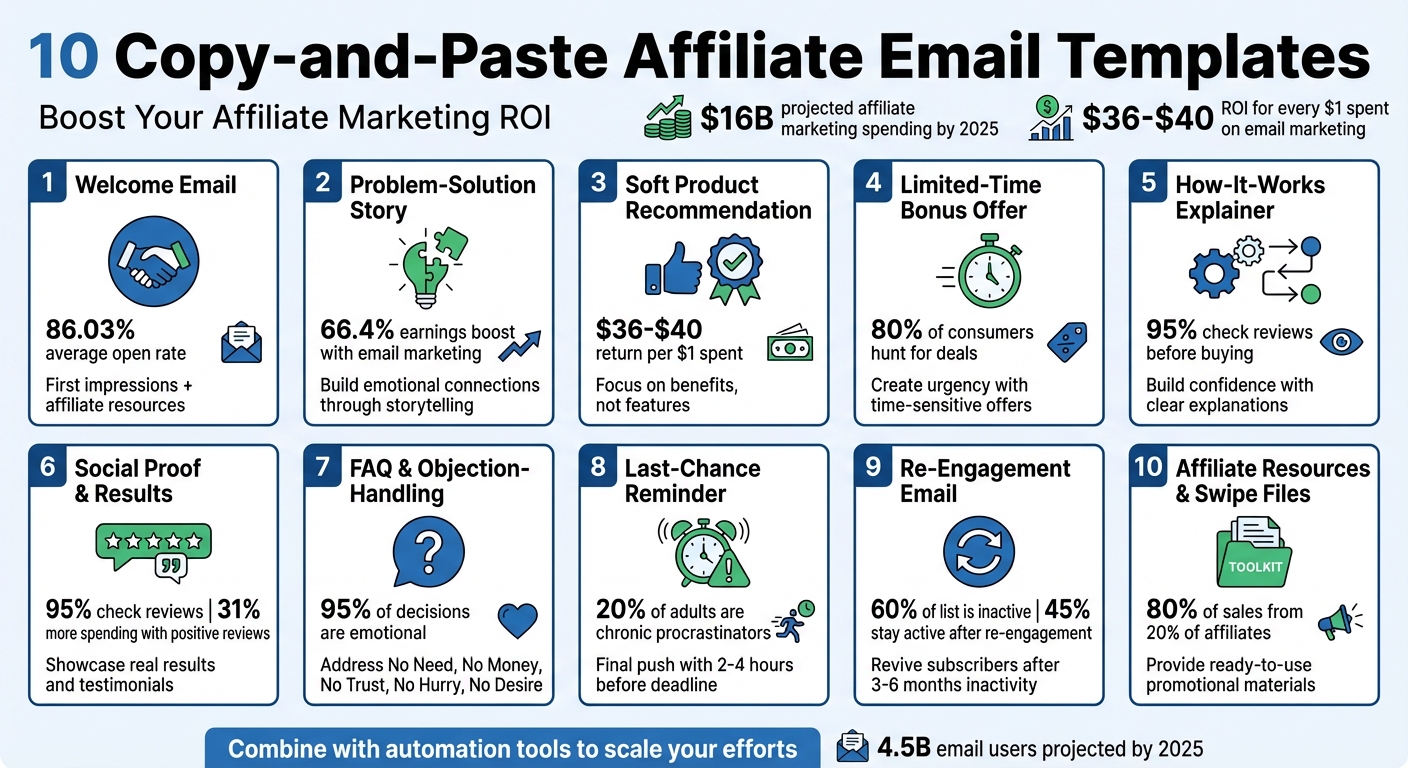
Affiliate marketers and program managers often struggle with writing effective emails for outreach, onboarding, and promotions. Pre-written email templates can save time, ensure clarity, and improve communication. With affiliate marketing spending projected to reach $16 billion by 2025 and email marketing delivering a $36–$40 ROI for every $1 spent, leveraging email templates is a smart move.
Here’s what you’ll get:
- Welcome Emails: First impressions matter – equip affiliates with links, resources, and a friendly tone.
- Problem-Solution Stories: Build emotional connections by addressing challenges and presenting solutions.
- Soft Recommendations: Suggest products by focusing on benefits, not features.
- Limited-Time Offers: Create urgency with time-sensitive bonuses or discounts.
- Explainers: Simplify how products work with clear, step-by-step breakdowns.
- Social Proof: Use testimonials and success stories to build trust.
- FAQ Emails: Address objections like cost or need with clear, concise answers.
- Last-Chance Reminders: Motivate procrastinators with urgent deadlines.
- Re-Engagement Emails: Revive inactive subscribers with incentives and reminders.
- Affiliate Resources: Provide ready-to-use materials like banners, swipe files, and guides.
Key takeaway: These templates streamline your email strategy, saving time while boosting affiliate engagement and sales. Combine them with automation tools to scale your efforts and maintain a professional, personalized touch.
10 Essential Affiliate Email Templates for Marketers
Affiliate Marketing Email Sequences with AI ✅ 10-Minute Tutorial
1. Welcome Email Template
Your welcome email plays a pivotal role in shaping the first impression for new affiliates. With an average open rate of 86.03%, it’s essential to make this message count. This email isn’t just a formality – it’s the foundation for a successful partnership.
The primary goal? Equip affiliates with everything they need from the start. Be sure to include their unique affiliate link, dashboard login credentials, and direct access to promotional materials like banners, swipe files, and brand kits. As Oleksii Petukhov, Affiliate Manager at Stripo, puts it:
"Generic emails end up in the trash. Make it personal and conversational, as if you’re inviting someone for a coffee, not sending a robot-like sales pitch".
Keep the tone friendly yet professional. Use the affiliate’s name, clearly explain your commission structure, and outline payout schedules to eliminate any confusion about earnings. Sending the email from a real person – like your affiliate program manager – helps establish trust right away.
To make things easier, include a link to a resource page or knowledge base for further details and encourage affiliates to bookmark their dashboard for quick access. Personal and celebratory subject lines, such as "Welcome to the [Your Company] Family, [First Name]! 🎉" or "You’re In, [Affiliate’s Name]! Welcome to [Your Brand]", work well. Considering that 64% of email recipients decide whether to open an email based solely on the subject line, these small touches can make a big difference.
Finally, automate this email to send immediately when someone joins your program. Tools like those from Your Automated Life can handle this effortlessly, ensuring every new affiliate feels welcomed without adding to your workload.
2. Problem-Solution Story Email Template
After the warm introduction of your first email, this template takes things further by creating a deeper emotional connection with your audience.
Instead of jumping straight into product features, this email focuses on showing readers that you understand their challenges. As Daniel P. Thrasher from ClickBank explains:
"Your job as an affiliate is not to sell the product but to warm up prospects so they are ready to buy when they land on the seller’s website."
The key here is to use the AIDA framework: grab Attention with a compelling hook, build Interest by touching on relatable struggles (like "finally getting a good night’s sleep" instead of technical specs), ignite Desire by painting a picture of transformation, and finish with a clear call to Action.
Take the ClickBank Smoothie Diet campaign as an example. The story of "Amanda", a mom of two who struggled with countless failed plans before discovering a simple "drink" that helped her lose 70 pounds, struck a chord with readers. Why? Because it reflected a common journey of frustration and hope, making the solution feel achievable and real.
To craft an effective email, start with a specific and intriguing hook. For example, mention a result like "lost 30 pounds" but keep the method mysterious, such as "with one simple morning ritual." This curiosity-driven approach works because email marketing can boost affiliate earnings by 66.4% compared to not using it.
Keep the story short and easy to skim. Wrap it up with a clear and compelling call to action like, "Click here to watch Amanda’s full story." The aim is to make the email feel personal and relatable, blending seamlessly into your affiliate campaign while driving engagement.
3. Soft Product Recommendation Email Template
Once you’ve built trust through storytelling, it’s time to introduce your affiliate product in a way that feels natural and helpful. This template works because it focuses on the results your reader wants, rather than just listing product features.
Instead of saying something like, "Get X cushion with soft branded materials", shift the focus to the benefit: "Sleep better every night with a cushion that feels just right". This subtle change makes your email feel like a thoughtful suggestion rather than a sales pitch. It connects the product to a real need, reinforcing the story you’ve already shared.
Keep your email short and to the point – under 150 words. Use bold text or bullet points to emphasize key benefits, making it easy for readers to skim. Add a personal touch by including the recipient’s name or referencing something specific about them, which helps avoid sounding robotic or impersonal.
Your call to action should feel easygoing. Phrases like "Learn more," "Check it out," or "See how it works" spark interest without pressuring the reader to buy immediately. You can also offer something valuable upfront, like a guide or a review, to naturally lead into the product recommendation.
With email marketing delivering a return of $36 to $40 for every $1 spent, this softer approach not only encourages clicks but also builds trust. The goal here isn’t to close the sale directly in the email – it’s to prepare your audience so they’re ready to act when they visit the product page.
4. Limited-Time Bonus Offer Email Template
A time-sensitive bonus can spark immediate action, especially when it taps into the fear of missing out. Here’s how to craft an email that gets your audience to act fast before the offer disappears.
Start with a subject line that signals urgency in under 50 characters. Phrases like "Last chance", "Ending soon", or "24 hours left" work well. Why? Because about 80% of consumers actively hunt for deals during promotional periods. Inside the email, follow the AIDA framework: grab Attention with your subject line, build Interest by describing the bonus, create Desire by showing how it could transform their lives, and drive Action with a clear call-to-action.
Keep your email concise – under 150 words. Use bold text or even a countdown timer to emphasize the deadline. Focus on the benefits of the bonus rather than listing features. For instance, instead of saying, "Get a free guide", say, "Learn the exact strategy that doubled my income in 90 days – yours free for the next 48 hours."
Make your call-to-action impossible to miss. A single, prominent button with clear instructions works best. To maximize results, consider a follow-up sequence: an initial announcement, a 24-hour reminder, and a final "last chance" email. Segment your audience to target deal-seekers while avoiding overexposure to full-price buyers.
With email marketing delivering $36 to $40 for every $1 spent, this strategy can significantly boost affiliate earnings while maintaining strong relationships. Done right, it’s a win-win: your emails stay persuasive, and your audience feels motivated to act.
5. How-It-Works Explainer Email Template
After establishing trust and highlighting benefits, this type of email shifts focus to explaining how the product works. Some people need to see the mechanics behind a product before they feel confident making a purchase. This template walks readers through the product’s functionality, features, and benefits in a way that builds confidence and eases doubts.
Start by using the Before-After-Bridge structure. First, describe the problem your audience is currently facing (Before). Then, show them what life could look like once the problem is solved (After). Finally, introduce the product as the bridge that connects the two. Instead of overwhelming readers with technical jargon, focus on the outcomes they care about. For example, rather than saying, "features advanced ergonomic design", say, "relieve back pain with a design that adapts perfectly to your body." This approach shifts attention to the results, not just the specs.
Break down how the product works into clear, simple steps. Use numbered points to explain its unique mechanism, and if applicable, mention any scientific research or expert validation that supports its effectiveness. Keep the explanation concise and easy to follow – showing that the solution is straightforward and doesn’t require much effort or expertise.
Wrap it up with a strong, action-oriented closing. Use calls-to-action like "Click here to see it in action" or "Watch the demo now". This approach not only educates but also reassures hesitant readers, turning them into confident buyers who know exactly what they’re getting.
sbb-itb-4bfa3ba
6. Social Proof and Results Email Template
Using social proof in an automated affiliate system is a smart way to save time while building trust. People rely heavily on genuine reviews – 95% of customers check reviews before making a purchase. This email template taps into that behavior by highlighting real results from actual users, making your affiliate recommendation feel like a reliable referral rather than a sales pitch.
Start with a clear, specific result to grab attention. For instance, "Sarah from Austin lost 32 lbs in 90 days" or "Over 18,000 small business owners trust this tool." Numbers add credibility, making the outcome feel real and achievable. Research even shows that positive reviews can encourage customers to spend 31% more, so showcasing measurable results can directly influence buying decisions.
To structure your email, follow the AIDA framework:
- Attention: Use a result-driven subject line, such as "How James Made $4,200 in His First Month."
- Interest: Share a relatable success story that resonates with your audience.
- Desire: Outline the steps leading to the result, showing how the transformation is possible.
- Action: End with a clear call-to-action, like "Learn how you can achieve this too."
Incorporate a mix of testimonials, expert endorsements, and case studies to appeal to different audiences. Customer testimonials are great for everyday products, while expert recommendations carry weight in technical or health-related niches. Before-and-after examples or detailed case studies can further illustrate how the product delivers results. For B2B products, focus on data and certifications; for B2C, lean on emotional stories and influencer endorsements.
Keep the tone genuine by including balanced reviews that acknowledge both pros and minor cons. This approach makes the content more relatable and trustworthy. Always wrap up with a strong call-to-action, like "See the full results here" or "Watch their story now", to guide readers to the next step.
7. FAQ and Objection-Handling Email Template
When prospects hesitate, it often boils down to one of five main reasons: No Need, No Money, No Hurry, No Desire, or No Trust. This email template is designed to tackle those hidden objections head-on before they derail the conversation. The key? Address the objection directly – questions like "Is this too expensive?" can actually help ease concerns by bringing them into the open. This strategy builds on the trust you’ve already established, making it easier to resolve doubts upfront.
Price objections are the most common, but they often signal deeper concerns. When someone says, "It’s too expensive", they’re usually saying, "I don’t see the value." Shift the focus to the return on investment by showcasing benefits like time saved, increased revenue, or specific problems solved. Avoid getting stuck on the price tag itself. As Harvard Professor Gerald Zaltman explains:
"95% of human decision making takes place below the conscious level, meaning we make 95% of our decisions based on emotion."
This underscores the importance of linking your product to an emotional outcome rather than just listing features. By doing so, you reinforce the idea that the value outweighs the cost.
To build on this, tailor your email’s FAQ section to your target audience. For instance, if you’re promoting software, address technical concerns. If it’s a health product, focus on safety questions or how quickly results can be seen. Use clear, concise formatting for your answers and back them up with social proof. Real testimonials or third-party reviews often carry more weight than claims from your brand.
Creating urgency is another essential piece of the puzzle. Highlight the risks of waiting too long – whether it’s missing out on a limited-time offer or staying stuck in their current situation. Psychologist Daniel Kahneman’s research shows:
"losses loom larger than gains."
This means people are more likely to act when they feel they’re avoiding a loss rather than chasing a win. Frame your FAQ responses to emphasize what they stand to lose by delaying action.
Finally, wrap up your email with a strong call-to-action like "Get started now." This clear direction helps guide prospects toward the next step and ties everything together as part of your broader affiliate email strategy. By addressing objections early and reducing uncertainty, this template makes it easier for prospects to say yes.
8. Last-Chance Reminder Email Template
When time is running out, a well-crafted last-chance email can spark immediate action. These emails leverage the psychological principle of loss aversion – the fear of missing out on a good opportunity. Interestingly, around 20% of adults are chronic procrastinators, often waiting until the last possible moment to make decisions. This template is tailored to appeal to that group.
Timing matters. For flash sales or limited-time offers, send your final reminder 2–4 hours before the deadline. This taps into the "now-or-never" mindset. Your subject line should highlight the urgency with phrases like "Ends in 2 Hours" or "Last Chance for 20% Off" to grab attention immediately.
In the email body, keep things brief and centered on what the recipient stands to lose if they don’t act. Include visual elements that create urgency, such as countdown timers or "low stock" notifications. Place a bold, clear call-to-action (CTA) button right at the top for maximum visibility. The message should make it crystal clear: the clock is ticking, and this is their final opportunity.
Use this strategy sparingly to avoid overwhelming your subscribers and eroding their trust. Ensure the email is mobile-friendly, with large, easy-to-click buttons for a seamless experience. The goal is to create a genuine sense of urgency while framing the reminder as a helpful nudge to prevent them from missing out.
9. Re-Engagement Email Template
Re-engagement emails are perfect for breathing life back into your inactive subscribers. Did you know that inactive subscribers often make up about 60% of your email list? While it’s normal for 25% of your contacts to disengage each year, the good news is that 45% of those who open re-engagement emails stay active.
The ideal time to launch a re-engagement campaign is after three to six months of inactivity. Start with a subject line that grabs attention or promises something valuable. For example, try "Is it us, or is it you?" or "Here’s what you’ve been missing." Adding a personal touch – like using the subscriber’s name or referencing their past behavior – can boost open rates by 26%. Inside the email, acknowledge their absence and remind them of what they’re missing out on.
To sweeten the deal, include an incentive they can’t ignore. This could be a 20% discount, a free e-book, a limited-time commission boost, or even a cash bonus for hitting a specific sales milestone within 30 days. Considering that it’s five times more expensive to acquire a new customer than to keep an existing one, offering something enticing is a smart investment. Make sure your email has a clear, actionable button like "Claim Your Gift" or "Reactivate My Account" so they know exactly what to do next.
For the best results, send out a series of two to three emails spaced 48 to 72 hours apart. Timing matters too – schedule these emails during high-engagement periods like breakfast, lunch, or early evening. If a subscriber doesn’t respond after the full sequence, it’s time to remove them from your list. This step helps maintain your sender reputation and keeps costs down.
10. Affiliate Resources and Swipe Files Email Template
Providing ready-to-use promotional materials can make a huge difference in how affiliates promote your brand. Nick Cotter, Founder & CEO of Growann, puts it perfectly:
"Make it easy for your affiliates to promote your brand and don’t give them an excuse to go to your competitors."
Since about 80% of sales often come from just 20% of affiliates, simplifying their promotional efforts can significantly improve results. A centralized system for delivering assets is key to making this process seamless.
Your resource email should feature a single, easy-to-access link to a dashboard, Google Drive, or Dropbox folder where all promotional materials are stored. Organize these assets into clear categories, such as:
- High-resolution logos
- Banner ads (static, animated, and HTML5)
- Email swipe files
- Social media templates
- Product images
You might also include comparison landing pages designed to help affiliates convert users who are still on the fence.
To guide affiliates further, include a "Getting Started" guide that explains how to use these materials effectively. Add sales scripts for overcoming objections and video tutorials or product demonstrations for extra support. Offering exclusive perks like coupon codes or lead magnets (e.g., e-books) can also motivate affiliates to promote your product more enthusiastically.
For swipe files, stick to plain-text formatting so affiliates can easily copy and paste them, even on mobile devices – a crucial consideration with over 4.5 billion email users projected by 2025. Lastly, keep your assets fresh. Update them regularly to reflect seasonal campaigns, product changes, or market trends. A dynamic affiliate toolkit ensures your partners always have what they need to succeed.
Conclusion
Pre-made affiliate email templates take the hassle out of crafting messages from scratch, allowing you to hit the ground running during crucial times like product launches or holiday sales. With email marketing delivering a strong ROI, these templates provide a structured way to drive more sales with less effort.
But it’s not just about saving time – templates help maintain a consistent brand voice. This consistency builds trust and encourages conversions, with 71% of consumers preferring brands they recognize and trust. Plus, templates ease the workload for managers and affiliates alike. Instead of starting fresh for every campaign, you can adapt a tried-and-true framework by adding personalized touches like names, metrics, or niche-specific details.
When you combine automation with personalization, you unlock scalable success. Freshworks puts it perfectly:
"Crafting the perfect affiliate marketing email is an art. It’s about striking a delicate balance: being professional yet personal, detailed but not overwhelming, and persuasive without being pushy".
Automate your welcome emails, follow-ups, and re-engagement campaigns, but don’t forget to add personal touches using custom fields to make each email feel relevant. Segment your affiliate lists by factors like performance or niche to ensure the right message reaches the right audience at the right time.
For an even smoother process, explore tools like Your Automated Life (https://yourautomatedlife.com). From building email sequences to integrating workflows, automation tools can help streamline your efforts while boosting results. This combination of automation, personalization, and reliable templates keeps your affiliate strategy on track and effective.
Affiliates who embrace these tools and strategies consistently outperform others. With the global affiliate marketing industry projected to hit $16 billion by 2025, now is the perfect time to adopt smarter systems that maximize efficiency and results.
FAQs
What’s the best way to personalize affiliate email templates?
Personalizing affiliate email templates can make all the difference when trying to grab attention in a packed inbox. Even with bulk emails, small details – like including the recipient’s first name or referencing their recent successes (e.g., "Your $2,300 referral payout last month") – can create a more personal and engaging tone.
Here’s how you can do this effectively:
- Leverage dynamic placeholders: Most email platforms allow you to use fields like {{first_name}} or {{last_month_sales}} to automatically customize emails for each recipient. It’s a simple way to make your message feel tailored.
- Show genuine interest: Reference something specific about their work, such as a recent blog post or video. This shows you’ve taken the time to learn about them, which can help build trust.
- Customize your offer: Segment your affiliates based on criteria like audience size, traffic source, or niche. Then, adjust your promotions or commission rates to better align with their goals and interests.
If you’re searching for tools to make this process easier, Your Automated Life offers AI-powered email scripts and workflows that simplify personalization, helping you strengthen your affiliate partnerships with minimal effort.
What are the best practices for automating affiliate email campaigns?
To automate affiliate email campaigns effectively, start by setting clear objectives for each email sequence. These could include welcoming new affiliates, promoting specific offers, or providing performance updates. Identify key triggers – like new sign-ups, completed purchases, or reaching milestones – that will activate your automated workflows. To avoid logical errors, consider using a visual flowchart to map out the entire process.
Make personalization a priority to keep your emails engaging. Add dynamic fields that include details like the affiliate’s name, earnings, or tailored product recommendations. For an even more personal touch, incorporate behavior-based offers or geo-targeted content, so your emails feel more like a direct conversation rather than a generic message. Regular testing of subject lines, different content formats, and optimal send times can help fine-tune your strategy for better results.
Select a dependable email service provider that offers features like segmentation, triggers, and A/B testing. Ensure your email lists are clean, authenticate your domain, and avoid using spam-trigger words to maintain strong deliverability rates. By blending strategic planning, data insights, and personalized automation, you can scale your affiliate campaigns while keeping them impactful and engaging.
How can I pick the best email template for different affiliate situations?
Choosing the right affiliate email template is all about understanding your goal and where you stand with the affiliate. If you’re welcoming a new partner, start with a welcome email that provides key details like tracking links, commission structures, and quick-start resources to help them hit the ground running. For potential affiliates, a recruitment email works best – highlight the benefits of your program and include a clear call to action that encourages them to join. For promotions with a deadline, go for a limited-time offer or seasonal promo email to create urgency – something like "Save 20% – Offer ends December 31, 2025" can be very effective.
When you’re promoting specific content, pick a template that aligns with the material. A product-promotion email is perfect for launches or spotlighting best-sellers, while a content-sharing email works well for blog posts, guides, or other resources. To keep affiliates motivated, consider a performance update or leaderboard email – these not only recognize top performers but also encourage a healthy sense of competition. If an affiliate has been inactive, a re-engagement email or a thank-you email can help rekindle their interest by acknowledging their past efforts and offering new incentives.
Always personalize your templates to fit the affiliate’s niche and ensure they follow U.S. conventions, like using dollar symbols ($), month-day-year date formats, and American spelling. Having ready-to-use templates at your disposal makes it easier to tailor your communication for any scenario, helping you achieve better results.