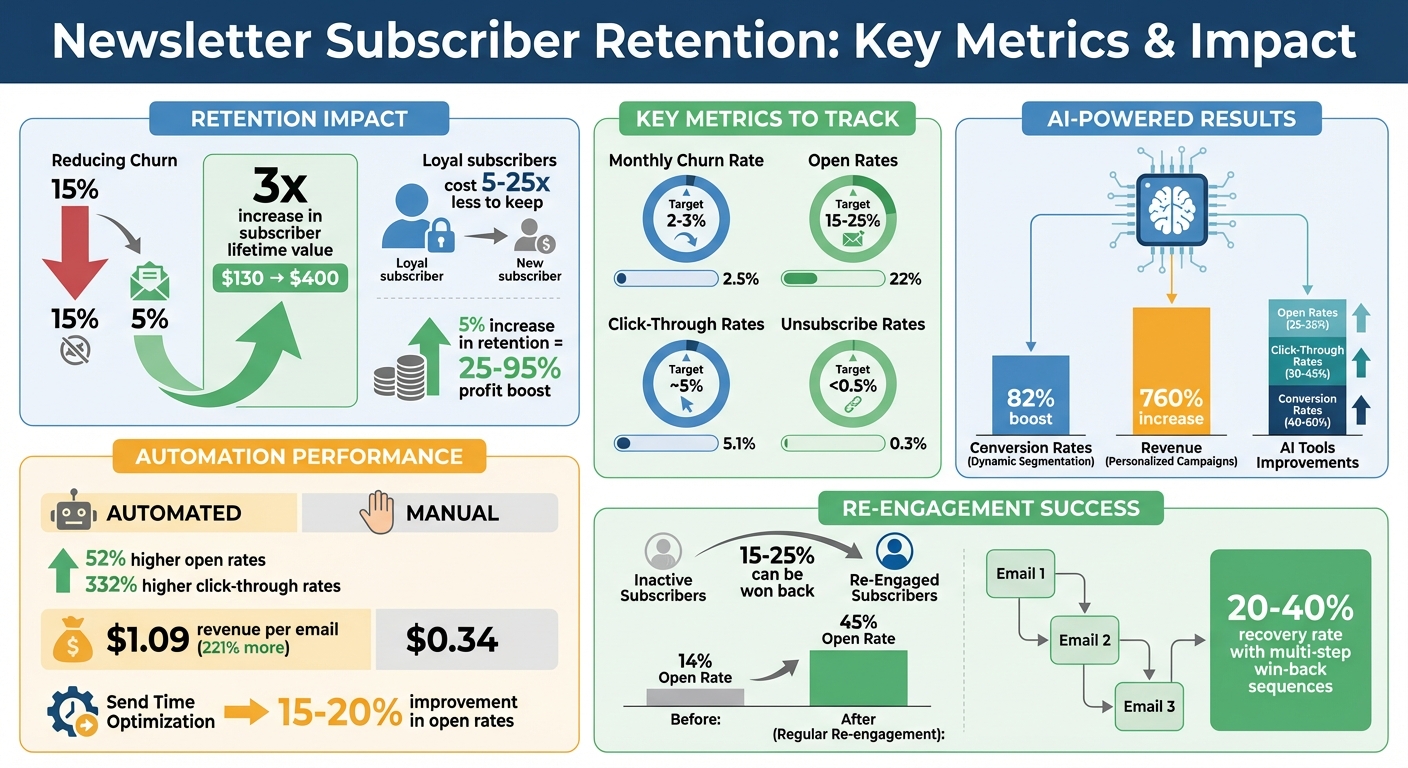
Want to keep your newsletter subscribers engaged and loyal? Here’s the bottom line: subscriber retention is the key to long-term growth and profitability. High churn rates can drain your resources, while improving retention can boost your revenue significantly. For instance, reducing churn from 15% to 5% can triple your subscriber lifetime value – from $130 to $400.
Here’s what you need to know to retain your audience:
- Retention matters more than growth. A loyal subscriber costs 5–25 times less to keep than acquiring a new one.
- Key metrics to track: Monthly churn (aim for 2–3%), open rates (15–25%), click-through rates (~5%), and unsubscribe rates (<0.5%).
- AI tools can help. From segmenting your audience to personalizing content and optimizing send times, AI makes retention easier and more effective.
- Content is king. Provide consistent, high-value emails that meet your audience’s needs. Mix up formats, include visuals, and use data to create relevant content.
- Engage your audience. Build a sense of community, offer perks like exclusive content or discounts, and use re-engagement campaigns to win back inactive subscribers.
- Test and refine. Use A/B testing to improve subject lines, CTAs, and send times. Track performance metrics like click-through rates and revenue per subscriber to adjust your approach.
Subscriber retention isn’t a one-time effort – it’s an ongoing process that combines strategy, data, and personalization. Start small by learning to create an automated email sequence or re-engagement campaign, and build from there. The goal is simple: keep your subscribers engaged, loyal, and converting.
Newsletter Subscriber Retention: Key Metrics and Impact Statistics
Retention framework for profitable newsletters in 2026
sbb-itb-4bfa3ba
Using AI to Personalize and Automate Newsletters
Relevance is the key to grabbing attention. Gone are the days when generic, mass emails could get the job done. AI has transformed time-consuming processes into real-time workflows that adapt to each subscriber.
Traditional segmentation relies on past behavior – like tracking who opened an email or clicked a link. AI, on the other hand, predicts what a subscriber is likely to do next. Whether it’s a purchase, disengagement, or interest in specific content, this forward-thinking approach helps keep subscribers engaged and loyal.
AI-Powered Audience Segmentation
AI goes beyond basic grouping. It identifies patterns and creates micro-segments that manual methods often overlook. For example, unsupervised learning can reveal subtle subscriber behaviors that allow for more personalized content at scale.
By assigning scores and adjusting segments in real time, AI makes it possible to act quickly. It flags subscribers at risk of disengaging and triggers tailored workflows, like win-back campaigns, right when they’re needed.
The benefits are impressive. Brands using dynamic, AI-driven segmentation have seen an 82% boost in conversion rates, while highly personalized campaigns have resulted in a 760% increase in revenue. As Gila from Ageless Revenue states:
"The biggest competitive advantage in the inbox is predictive relevance."
AI also helps manage email frequency by recognizing early signs of fatigue. It automatically reduces the number of emails sent to those showing signs of disengagement. This "segment-of-one" approach ensures every subscriber receives content tailored just for them, replacing generic newsletters with highly individualized streams.
For those looking to dive in, platforms like Your Automated Life offer easy-to-follow workflows and pre-built automations to simplify AI integration.
But segmentation is just one piece of the puzzle. AI also plays a game-changing role in creating content that connects.
Dynamic Content Creation with AI
AI doesn’t just decide who gets your emails – it also determines what goes in them. Tools like Migma can generate everything from copy to images and layouts based on a simple prompt or URL. Its "Compatibility Checker" ensures emails display correctly across all major clients. For eCommerce, Klaviyo‘s K:AI acts as a virtual marketing assistant, using predictive analytics to create email sequences with product recommendations tailored to each subscriber.
The impact is hard to ignore. AI-powered tools have improved open rates by 25–35%, click-through rates by 30–45%, and conversion rates by 40–60%. For eCommerce brands, AI-driven product recommendations can account for 10–30% of total email revenue.
Different platforms cater to various needs. HubSpot‘s Breeze AI integrates with CRM systems to score leads and even handle support tickets via email. Mailchimp offers basic AI tools in its Standard plan (around $20/month), while advanced features like predictive analytics are available in Premium plans (starting at $350/month). For enterprise-level solutions, Phrasee focuses on optimizing subject lines, and Movable Ink specializes in real-time, one-to-one content personalization.
Looking ahead, Email SEO is becoming a critical trend. With platforms like Gmail and Apple Mail generating AI-powered summaries, it’s essential to place key value propositions at the top of your emails. As Digital Applied points out:
"The marketers winning this AI arms race aren’t just using AI tools – they’re optimizing for how recipient AI interprets their messages."
While AI can handle much of the heavy lifting, reviewing its output ensures the content aligns with your brand voice. Spam filters are increasingly sensitive to generic, AI-generated patterns, so a human touch is still crucial.
Once you’ve nailed segmentation and content, the next step is perfecting your send strategy.
Automating Send Times and Follow-Ups
Timing can make or break engagement. AI-driven Send Time Optimization (STO) has been shown to improve open rates by 15–20%.
With Apple’s Mail Privacy Protection (MPP) affecting open-time data, platforms now rely on click-based and conversion-based metrics to predict the best send times. These more reliable signals allow AI to craft precise engagement strategies.
Automated emails consistently outperform manual campaigns, achieving 52% higher open rates and 332% higher click-through rates. They also generate 221% more revenue per email – for instance, $1.09 compared to $0.34 – while cutting management time in half.
AI can trigger emails based on real-time behavior. For example, an abandoned cart email should be sent within an hour, not the next day. A strong welcome sequence might include five emails over 14 days, while re-engagement campaigns should begin after 90 days of inactivity. If there’s no response by 120 days, it’s best to remove the subscriber to maintain a good sender reputation.
| Automation Type | Trigger | Recommended Duration |
|---|---|---|
| Welcome Sequence | New opt-in | 5 emails over 14 days |
| Abandoned Cart | Cart left (1 hour) | 3 emails over 72 hours |
| Post-Purchase | Transaction completed | 4 emails over 14 days |
| Re-engagement | 90 days inactivity | 3 emails over 14 days |
Exit logic is equally important. Once a subscriber completes an action, such as making a purchase, they should automatically exit the sequence to avoid unnecessary follow-ups.
The latest advancements include autonomous workflows, where AI tools like Klaviyo’s K:AI or HubSpot’s Breeze handle entire sequences and even resolve support tickets without human input. To ensure accuracy, allow AI platforms at least 30 days of data to learn engagement patterns before relying on automated send-time optimization.
Re-engagement sequences, when done well, can win back 15–25% of inactive subscribers. Combined with broader AI strategies, these efforts have led to conversion rate increases of 40–60% and a 240% ROI boost within six months.
Creating High-Value, Consistent Content
AI and automation can help you deliver emails at the perfect time, but what you say is just as important as when you say it. Subscribers stick around because they trust you to provide value every time they open your newsletter. This means understanding their needs, mixing up content formats, and using smart tools to stay consistent without burning out.
Understanding What Your Audience Wants
The best content strategies start with listening. Tools like surveys, polls, and direct email replies are simple ways to discover what your subscribers care about most. Ask them about their challenges, preferred topics, or even the ideal format for their schedule. Airbnb, for instance, analyzes travel preferences and past bookings to send personalized destination recommendations and seasonal travel guides.
Behavioral data is another goldmine. Track which links get clicked, which emails are opened, and which pages on your site attract attention. This data helps you tag interests and segment your list automatically. For example, if someone repeatedly clicks on content about passive income strategies, it’s a clear signal of their interests. Tools like Your Automated Life can help you monitor these patterns and identify which content types – whether personal stories, how-to guides, or data-backed listicles – lead to the most conversions.
Advanced segmentation takes it a step further. Divide your list based on demographics, purchase history, location, or engagement levels (like highly active vs. less engaged subscribers). Newsletters that use advanced segmentation can generate 3x to 5x more revenue per subscriber. The trick is to make every email feel personal, as though it was written specifically for that individual.
Once you understand what your subscribers want, the next step is to keep them engaged by varying your content formats.
Diversifying Content Formats
Sending the same type of email week after week can lead to boredom. Mixing up your content keeps your readers engaged and eager for more. Try rotating between educational articles, behind-the-scenes updates, expert interviews, success stories, and practical how-to guides. Each format serves a unique purpose: educational pieces build credibility, behind-the-scenes content adds personality, and how-to guides offer immediate value.
Grammarly excels at this. Their newsletters include writing tips, feature updates, and free premium trials, ensuring there’s always something fresh for their audience.
Don’t overlook visual elements. Use infographics, videos, and interactive features like GIFs to break up text and boost engagement, especially for mobile users. With mobile traffic often surpassing desktop, responsive design and concise formatting are essential.
Another powerful approach is creating compounding value. Think of your newsletter as an evolving resource rather than a collection of one-off updates. Reference earlier issues, follow up on past insights, and build frameworks that grow over time. This creates a sense of continuity and turns your newsletter into an indispensable resource rather than a fleeting read.
Leveraging AI for Scalable Content Creation
Producing consistent, meaningful content every week can be exhausting. That’s where AI can step in. AI tools can automate research by scanning websites, RSS feeds, and social media to identify trending topics in your niche. They can also summarize long-form content – like industry reports or podcasts – into digestible bullet points for quick curation.
Generative AI can even help draft sections of your newsletter, from headlines to body text, allowing you to focus on refining the content rather than starting from scratch. A streamlined workflow might include 30–45 minutes for AI-assisted research, 30 minutes for drafting, and 15–30 minutes for adding your personal insights and fact-checking. AI-assisted tools can speed up newsletter creation by 10× compared to manual methods.
However, AI is a tool – not a replacement for your voice. As TrendVibz puts it:
"AI is a productivity multiplier – but your unique voice, curation, and editorial judgment are the durable advantages."
Use AI to handle repetitive tasks while maintaining your unique perspective. Platforms like Your Automated Life provide workflows and templates to simplify AI integration, helping you stay consistent without compromising on quality. With the right tools, newsletters can see a 200–400% increase in signups within 90 days.
The goal isn’t to remove the human touch – it’s to protect it. Let AI manage the heavy lifting so you can focus on delivering the insights, stories, and perspectives that only you can provide. By blending personalized content with AI-powered efficiency, you’ll keep subscribers engaged and coming back for more.
Engaging and Retaining Your Subscriber Base
Great newsletters might grab attention, but keeping your subscribers engaged is what truly builds loyalty. When newsletters evolve into communities, engagement rates can increase by over 40%, and those community members are likely to spend three times more than passive readers.
Building Community Around Your Newsletter
Creating a sense of community starts with a conversational tone. Writing as if you’re speaking directly to one person – using "you" and "I" – helps foster a personal connection. Encourage replies to your emails and take the time to respond personally. This builds trust and signals value to email providers.
You can also spotlight your readers through Q&As, success stories, or quotes, making them feel seen and valued. To extend the connection beyond email, consider creating spaces like Discord servers, Slack channels, or private Facebook groups. Hosting live events, such as monthly Zoom calls, Q&A sessions, or YouTube streams, adds a face-to-face element that strengthens relationships.
Engagement grows when you involve your audience in collaborative projects. Short-term challenges, crowdsourced resources, or surveys can turn passive readers into active participants. For your most dedicated subscribers, a VIP program offering perks like early content access or exclusive calls can deepen their involvement.
A practical tip: when engaging in comment sections or forums, wait at least an hour before replying. This allows others to join the conversation organically.
These efforts lay the groundwork for offering rewards that keep subscribers loyal.
Offering Exclusive Perks and Benefits
Content alone isn’t always enough to retain subscribers – adding perks can make a big difference. Even a 5% increase in customer retention can boost profits by 25% to 95%. Start with perks like early access to content, exclusive tutorials, or limited-edition resources. Financial incentives, such as free shipping, subscriber-only discounts, or secret sales, can also be powerful motivators.
For deeper connections, offer experience-based rewards. Host exclusive events, networking opportunities, or create members-only spaces where subscribers can connect. For your top-tier subscribers, consider offering one-on-one consultations or priority customer support.
Another effective approach is tenure-based rewards. Implement loyalty programs with tiers (e.g., Gold, Platinum) to reward long-term subscribers. Surprise them with gifts for milestones like their fifth or tenth order, or even their subscription anniversary. These gestures create emotional ties that make leaving feel like a loss.
Empower your audience by letting them vote on upcoming topics. And instead of losing subscribers completely, offer a "pause" option for 1–3 months. This strategy has proven effective, with paused subscriptions increasing by 68% year-over-year in 2024, generating over $200 million in reactivated revenue.
While perks and rewards build loyalty, AI can help you stay ahead by personalizing outreach and re-engaging subscribers at the right time.
Using AI for Proactive Engagement
AI is a game-changer for subscriber retention. Predictive analytics can spot users at risk of leaving, giving you the chance to intervene early. AI also identifies peak moments of interest – like when a subscriber clicks a link or downloads a resource – and sends timely, personalized follow-ups.
For inactive subscribers, create a multi-step win-back sequence. A series of three to four emails over 7–10 days, starting with a friendly reintroduction and ending with a "last chance" message, can recover 20% to 40% of inactive users. Regular re-engagement campaigns have been shown to increase open rates from 14% to 45%.
Streamline your onboarding process by automating it. Instead of overwhelming new subscribers with a long welcome email, send bite-sized content over several days or weeks. Use click data to tag subscribers and trigger tailored nurture flows. As Ryan Robinson notes:
"When someone replies to your automation emails, that’s a signal of real engagement. Better engagement improves email deliverability."
Finally, maintain a healthy email list by setting a sunset policy. For example, remove contacts after 180 days of inactivity. Tools like Your Automated Life offer pre-built workflows and templates to simplify these AI-driven strategies, so you can focus on delivering the right message at the right time. The ultimate goal? Keep subscribers engaged and loyal before they even think about leaving.
Testing and Optimizing Retention Strategies
Retention isn’t a one-and-done task – it’s an ongoing process that thrives on testing, feedback, and adjustment. Just like AI-powered personalization, refining your strategies over time is key to keeping your audience engaged. For instance, email marketing can deliver high ROI, but only if you consistently tweak your approach based on real data.
A/B Testing for Better Results
A/B testing is a powerful way to uncover what works best for your subscribers. By testing one variable at a time – like subject lines, CTA buttons, or send times – you can improve open and click rates by 10–25%. Start with a clear hypothesis, such as tweaking a subject line to boost open rates.
Personalized subject lines, for example, can increase open rates by 26% to 50%. Testing different CTA designs can lead to click-through rate improvements of up to 300%. Even send times matter – experiment with windows like 4 AM, 6 AM, 9 AM, or 6 PM. Over half of emails are opened within the first six hours, so timing can make a big difference.
When running A/B tests, deploy variations to a smaller audience segment before rolling out the winning version to your entire list. To ensure statistically significant results, run tests for 2 to 48 hours with at least 1,000 recipients. Once you’ve identified the winning variation, monitor its performance metrics to confirm the results.
Tracking Performance Metrics
While open rates offer some insight into subject line effectiveness, they’ve become less reliable due to features like Apple’s Mail Privacy Protection. Instead, focus on metrics like click-through rate (CTR) and click-to-open rate (CTOR) to assess how well your content connects with your audience.
Dig deeper into metrics like Revenue Per Subscriber (RPS), which you can calculate by dividing total revenue by total subscribers. This approach shifts the focus from list size to actual revenue impact. As one expert highlighted:
"In 2026, list size alone is meaningless. A 50,000-subscriber newsletter earning $1,000/month is weaker than a 5,000-subscriber newsletter earning $5,000/month." – Newsletter Valuator
To better understand which content drives revenue, use UTM parameters for tracking. For example, adding utm_source=newsletter to your links can help you attribute revenue to specific campaigns. Tools like Your Automated Life offer pre-built workflows to simplify this process. Marketers who leverage email analytics are 45% more likely to boost revenue compared to those relying on guesswork. Allow 4–5 days after sending emails before drawing conclusions, as subscriber behavior varies.
Combine these metrics with subscriber feedback to continuously refine your strategies.
Iterating Based on Feedback
Subscriber feedback is just as important as data. A preference center lets users control the type and frequency of content they receive, which can reduce unsubscribes and provide valuable first-party data for personalization.
Pay attention to direct replies and use surveys to gather actionable insights. For instance, include a short survey on your unsubscribe page to find out why readers are leaving. Common reasons include receiving too many emails or irrelevant content. If frequency is a recurring issue, consider offering an "opt-down" option instead of a full unsubscribe.
Segmenting your audience by engagement level can also help. For example, offer exclusive content to highly engaged subscribers while sending win-back campaigns to those who are less active.
"Email performance optimization is a journey, not a destination. Making small adjustments and testing them over time is the best route to take." – MailerLite
Finally, document everything. Maintain a testing log that tracks changes, metrics, and outcomes. This turns retention efforts into a repeatable, scalable process rather than relying on guesswork.
Conclusion
Sending the right email at the right time is the cornerstone of effective retention. This guide has explored how AI tools and automation workflows can turn retention into a scalable, efficient process. By leveraging behavioral triggers, personalized content, and smart send-time optimization, you can capture critical engagement moments that manual efforts often miss.
The impact of automation is hard to ignore. For instance, cutting monthly churn from 15% to 5% can triple subscriber lifetime value – from $130 to $400. Think of it like replacing a teaspoon with an industrial pump to fill a pool – it’s a game-changer. Platforms like Your Automated Life offer pre-built workflows and guides to simplify the process. Whether it’s a 3-email welcome series, re-engagement campaigns for inactive subscribers, or AI-driven personalized content, the tools are there to make retention easier to manage.
That said, automation isn’t a “set it and forget it” solution. Regular audits, A/B testing, and subscriber feedback are essential to keep your workflows effective and relevant. As Kostadin Ristovski wisely put it:
"Growth without retention is a treadmill. You keep running; you don’t move forward."
Start small – perhaps with a welcome series or a re-engagement campaign – and build from there. The goal is to create a retention system that grows over time, transforming your newsletter into a long-term asset rather than a constant struggle for new subscribers.
FAQs
What should I do first to reduce newsletter churn?
To keep your newsletter subscribers engaged and prevent churn, it’s important to set clear expectations right from the start. Make sure your email signup description outlines exactly what kind of content they’ll receive and how often they can expect to hear from you. Being upfront like this helps avoid misunderstandings and minimizes early unsubscribes, ensuring your audience knows what they’re signing up for.
How can I use AI without losing my brand voice?
To make AI work within your brand voice, start by training it with your specific tone, style, and personality guidelines. Share examples of your existing content to give AI a clear sense of your voice, and establish clear boundaries to maintain consistency.
Combine AI-generated content with human oversight to preserve authenticity and ensure an emotional connection with your audience. Regular reviews of AI outputs are essential to confirm they stay true to your brand identity. This way, AI can enhance your messaging while keeping the irreplaceable human element intact.
Which retention metric matters most if open rates are unreliable?
The paid conversion rate from engaged readers stands out as the key retention metric when open rates become unreliable. This metric goes beyond simply tracking email opens – it focuses on the actual value subscribers bring and provides a more accurate view of how your newsletter is performing.